The Federal
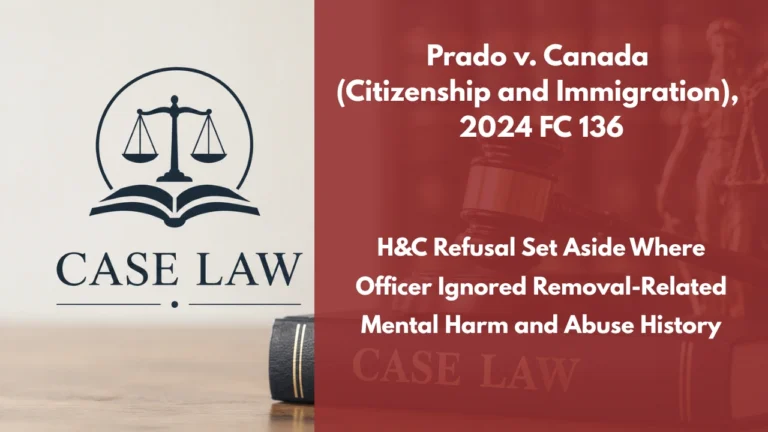
Court reviewed the refusal of Barbara Silva Prado’s H&C application for PR.
She relied on serious mental health concerns, the breakdown of an abusive
marriage and proposed spousal sponsorship, and a long history of family
violence before coming to Canada. The Court granted judicial review because the
officer assessed these factors narrowly and separately rather than
substantively considering their combined humanitarian significance.
Key
Principle
An H&C officer must assess the applicant’s circumstances globally
and substantively weigh all central factors. When psychological evidence states
that removal itself may worsen a mental health condition, it is not sufficient
to consider only whether treatment is available abroad. The officer must also
meaningfully consider how domestic violence, sponsorship breakdown, past abuse,
and the loss of a Canadian support network affect hardship.
Background
The
applicant came to Canada as a visitor and later married a Canadian citizen. She
described abuse by her husband, including threats to report her lack of status,
and left the relationship before the planned sponsorship application was
submitted.
Her H&C
application included a statutory declaration, psychological evidence diagnosing
Post-Traumatic Stress Disorder and Major Depressive Disorder, and evidence
concerning abuse experienced both in Canada and before her arrival.
Court
Findings
•
Removal-Related Mental Harm Was Not Assessed
The
psychological report stated that returning to her country of citizenship would
likely trigger psychological decompensation, increase her symptoms, and reduce
her ability to perform basic tasks and work. The officer focused instead on
whether mental health treatment was available abroad and did not assess the
distinct harm caused by removal itself.
• Mental
Health Analysis Was Unduly Narrow
The Court
found the officer’s approach similar to the error identified in Kanthasamy. By
reducing the issue to treatment availability, the officer failed to consider
the applicant’s diagnosis, trauma history, present vulnerability, and the
anticipated psychological consequences of being returned to the environment
connected to that trauma.
• Abusive
Sponsorship Breakdown Was Ignored
The
applicant explained that she left an abusive Canadian spouse and therefore lost
the opportunity to obtain PR through spousal sponsorship. Although this was a
central H&C factor and official guidance specifically directs sensitivity
to such circumstances, the officer merely recited parts of the relationship
history without weighing its humanitarian significance.
• Past
Family Violence Was Mischaracterized
The
applicant provided detailed evidence of neglect and abuse beginning in
childhood and continuing until she left. The officer treated this history
principally as a question of future physical danger, rather than examining how
the past mistreatment continued to affect her mental health, resilience, and
ability to reintegrate.
• Canadian
Support Network Was Assessed Mechanically
The officer
stated that the applicant could maintain friendships electronically after
removal. This failed to recognize that her Canadian support network was
identified as important to her psychological stability and recovery from
domestic abuse, making its loss more significant than ordinary separation from
friends.
•
Circumstances Were Improperly Segmented
The officer
considered treatment, establishment, employment, and hardship in separate
compartments. This fragmented approach prevented a meaningful assessment of how
the applicant’s abuse history, mental illness, failed sponsorship, and reliance
on Canadian supports interacted and collectively supported compassionate
relief.
Outcome
The Federal
Court granted judicial review, set aside the H&C refusal, and returned the
application to a different officer for redetermination. No question was
certified.
Case
Citation:
Prado v. Canada (Citizenship and Immigration), 2024 FC 136 (CanLII)
Prepared by:
Dr. Muhammad
Abrar (Barrister and
Solicitor)
Author | Writer | Mentor | Legal Researcher | Canadian Immigration Case Law and
Statistics Analyst