The Federal
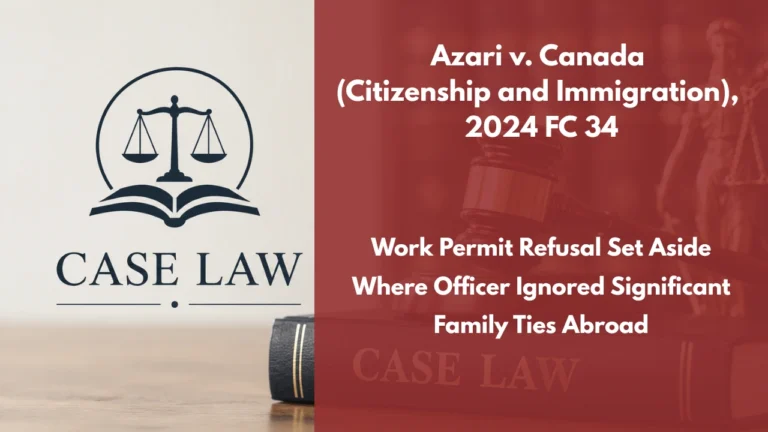
Court reviewed the refusal of Kamyar Ahmadi Azari’s LMIA-supported work permit
application for employment as a cabinet maker. The officer was not satisfied
that he would leave Canada after his authorized stay, relying on his financial
circumstances and an alleged absence of significant family ties abroad. The
Court granted judicial review because the family-ties conclusion directly
contradicted the application record and was left entirely unexplained.
Key
Principle
A work
permit officer must assess temporary intent in light of the evidence actually
submitted. Where an applicant’s family information form identifies several
immediate family members living abroad, the officer cannot reasonably conclude
that the applicant lacks significant family ties outside Canada without
addressing that evidence. A material finding that contradicts the record
requires a transparent and intelligible explanation.
Background
The
applicant was a 29-year-old single man who applied for a high-wage,
LMIA-supported work permit to work as a cabinet maker. The officer found that
he had submitted insufficient documentation concerning his financial position
and establishment abroad.
The officer
also concluded that he lacked significant family ties outside Canada. However,
his family information form showed that his mother, father, sister, and one
brother lived abroad, while only one brother lived in Canada.
Court
Findings
•
Family-Ties Evidence Directly Contradicted the Refusal
The
applicant’s family information form clearly identified four close family
members residing abroad. This evidence was inconsistent with the officer’s
conclusion that he did not have significant family ties outside Canada, yet the
reasons did not acknowledge or reconcile the contradiction.
• Immediate
Family Abroad Was Material to Temporary Intent
The
applicant’s parents, sister, and brother represented important personal
connections to his home country. These relationships were relevant pull factors
supporting his intention to return after the authorized employment period and
therefore required meaningful consideration.
• One
Brother in Canada Did Not Eliminate Ties Abroad
Although the
applicant had one brother living in Canada, most of his immediate family
remained abroad. The officer did not explain why the presence of one Canadian
sibling outweighed or neutralized the applicant’s substantially broader family
network in his home country.
• GCMS Notes
Contained No Family-Ties Analysis
The GCMS
notes referred to the applicant as highly mobile and stated that he had not
established sufficient ties to his home country. They did not identify the
family evidence, explain how it was weighed, or provide any reasoning
supporting the adverse family-ties conclusion.
•
Contradictory Evidence Required Express Engagement
An officer
is not required to discuss every document in an application. However, when
evidence directly contradicts a central refusal ground, the absence of any
reference to that evidence may demonstrate that it was overlooked or
fundamentally misapprehended.
• Error Was
Sufficient to Invalidate the Decision
The Court
treated the family-ties finding as determinative and did not need to resolve
the applicant’s remaining arguments concerning finances or establishment.
Because the unsupported finding formed part of the temporary-intent assessment,
the decision lacked justification, transparency, and intelligibility.
Outcome
The Federal
Court granted judicial review, set aside the work permit refusal, and returned
the application to a different officer for redetermination. No question was
certified.
Case
Citation:
Azari v. Canada (Citizenship and
Immigration), 2024 FC 34 (CanLII)
Prepared by:
Dr. Muhammad
Abrar (Barrister and
Solicitor)
Author | Writer | Mentor | Legal Researcher | Canadian Immigration Case Law and
Statistics Analyst