The Federal
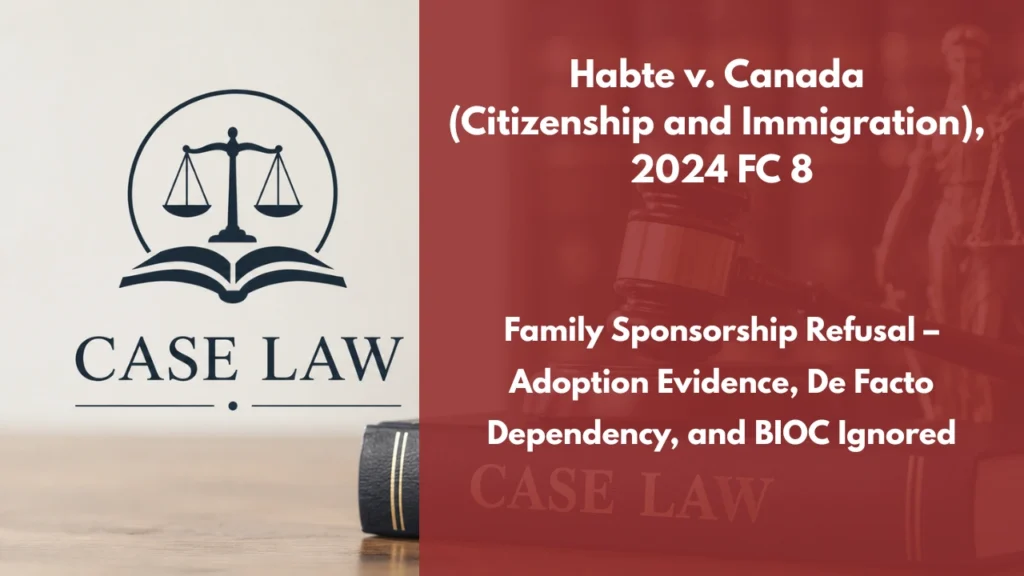
Court reviewed the refusal of Semhar Gebrezgiabeher Habte’s PR application as
the family member of a protected person. The officer was not satisfied that she
was legally adopted by her aunt and did not assess whether she qualified as a
de facto family member. The Court granted judicial review because the officer
rejected foreign adoption evidence without an objective foundation and failed
to address central dependency and family-relationship evidence.
Key
Principle
Foreign public documents should generally be accepted as authentic
unless there is an evidentiary basis for doubting them. Where the record
clearly shows emotional and financial dependency resembling a family
relationship, an officer may be required to assess de facto family membership
even if the applicant does not expressly request that analysis. Relevant
child-interest considerations must also be addressed when the evidence
establishes continuing dependency on a parental figure.
Background
The
applicant alleged that her aunt adopted her after her biological mother died.
The aunt later obtained refugee protection in Canada and identified the
applicant as her adopted daughter.
The
applicant submitted an adoption certificate, birth and death records, childhood
photographs, money-transfer evidence, and communications showing an ongoing
relationship. The officer nevertheless found that the legal adoption had not
been established.
Court
Findings
• De Facto
Family Relationship Required Assessment
The record
contained evidence that the applicant and her sisters had lived together as a
family and that her aunt continued to provide financial support. These facts
were sufficiently apparent that the officer was required to consider whether
the applicant was a vulnerable person emotionally and financially dependent on
a family member in Canada.
• Express
Request Was Not Necessary
The Minister
argued that the officer did not need to assess de facto family membership
because the applicant had not specifically requested it. The Court rejected
this position because a first-instance officer must respond to material issues
clearly arising from the evidence and statutory context.
• Adoption
Certificate Was Rejected Without Objective Evidence
The adoption
decree purported to have been issued by an Eritrean court. The officer declared
it inauthentic without identifying reliable country evidence, verification
results, or applicable legal requirements showing that the issuing court lacked
authority or that the document’s form was invalid.
• Document’s
Appearance Was an Insufficient Basis
The officer
relied partly on the adoption document being printed on plain paper. Without
evidence that authentic adoption decrees from the relevant authority are issued
in a different form, this observation could not reasonably support a finding of
fraud or inauthenticity.
•
Corroborating Relationship Evidence Was Inadequately Addressed
The
applicant provided photographs, communications, financial transfers, civil
records, and evidence that her aunt had consistently identified her as an
adopted child. The reasons did not meaningfully analyze how these materials
affected the claimed legal or practical parent-child relationship.
•
Child-Interest Considerations Were Overlooked
The
applicant also argued that her dependency on her adoptive mother required
consideration of her best interests. The Court agreed that the officer’s
failure to engage with this issue, together with the omitted de facto-family
analysis, left the decision unjustified in light of the record.
Outcome
The Federal
Court granted judicial review, set aside the PR refusal, and returned the
application to a different decision-maker for reconsideration. No question was
certified.
Case
Citation:
Habte v. Canada (Citizenship and Immigration), 2024 FC 8 (CanLII)
Prepared by:
Dr. Muhammad
Abrar (Barrister and
Solicitor)
Author | Writer | Mentor | Legal Researcher | Canadian Immigration Case Law and
Statistics Analyst