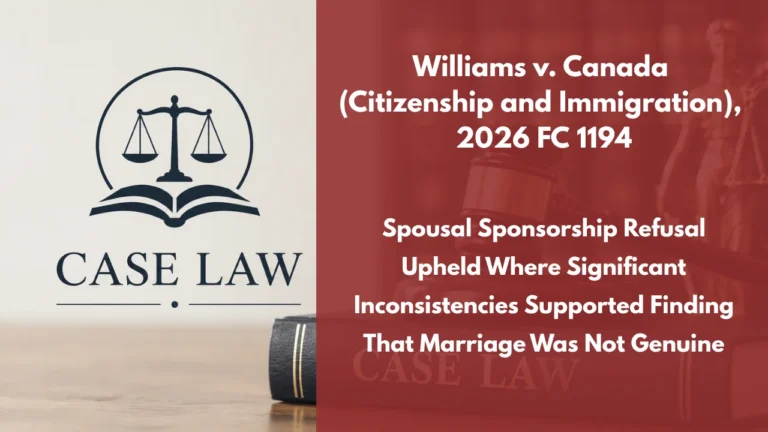
The Federal Court dismissed judicial review of a refusal of
a family-class permanent residence application where the officer was not
satisfied that the Applicant’s marriage was genuine under subsection 4(1) of
the Immigration and Refugee Protection Regulations. The Court found that
the officer reasonably assessed the evidence and identified multiple
significant inconsistencies concerning the couple’s financial arrangements,
personal circumstances, and knowledge of each other.
Key Principle
An officer assessing the genuineness of a spousal
relationship may consider the surrounding circumstances of the relationship,
including the timing of previous divorces, family circumstances, financial
arrangements, and inconsistencies in the spouses’ accounts. A piece of evidence
does not necessarily have to be expressly mentioned in the reasons where the
officer’s analysis demonstrates that the underlying issue was considered.
Background
The Applicant, a Nigerian citizen, had previously been
married and had two children from that relationship who were living in Canada
on study visas. She was divorced in November 2020. Her Canadian-citizen spouse
had also previously been married and was divorced in March 2020. The couple
married in April 2023, and the Applicant subsequently applied for permanent
residence under the family class with her spouse as sponsor.
The officer refused the application after concluding that
the marriage was not genuine and had been entered into primarily for obtaining
status or a privilege under the IRPA. The Applicant withdrew her
procedural fairness arguments at the hearing, leaving the reasonableness of the
genuineness finding as the sole issue before the Court.
Court Findings
• Lease evidence did not undermine the officer’s
reasoning
The Applicant argued that the officer failed to consider a
lease renewal agreement signed by both spouses as evidence of cohabitation. The
Court rejected this argument. The officer’s concern was not whether the lease
had been properly executed, but who actually paid the rent. The Applicant gave
inconsistent accounts about the source of the rent payments, which reasonably
raised credibility concerns.
• Previous divorces were relevant
The Court held that the timing of the spouses’ previous
divorces was relevant to assessing the genuineness of the marriage. Their
proximity to the subsequent sponsorship application was a circumstance the
officer was entitled to consider in the immigration context.
• Children in Canada could be considered as a pull factor
The officer was entitled to consider that the Applicant’s
two children were already living in Canada. Although the desire to remain close
to family is natural, the Court found it reasonable for the officer to regard
the children’s presence as an incentive to seek an immigration pathway,
including through a marriage of convenience.
• Multiple inconsistencies supported the finding
The officer identified several inconsistencies during the
couple’s interviews, including conflicting evidence regarding household
expenses and payment arrangements, the sponsor’s answers concerning the
Applicant’s siblings, discrepancies between addresses appearing on documents,
and the spouses’ lack of knowledge of each other’s mothers. The Applicant did
not seriously dispute many of these inconsistencies.
The Court found that, viewed cumulatively, these
inconsistencies provided substantial support for the officer’s conclusion that
the marriage was not genuine.
Outcome
The Court concluded that it was reasonably open to the
officer to find that the marriage was not genuine and that the reasoning was
clear and supported by the record. The judicial review application was dismissed,
and no question was certified.
Case Citation:
Williams v. Canada (Citizenship and Immigration), 2026 FC 1194 (CanLII)
Prepared by:
Dr. Muhammad
Abrar (Barrister and
Solicitor)
Author | Writer | Mentor | Legal Researcher | Canadian
Immigration Case Law and Statistics Analyst