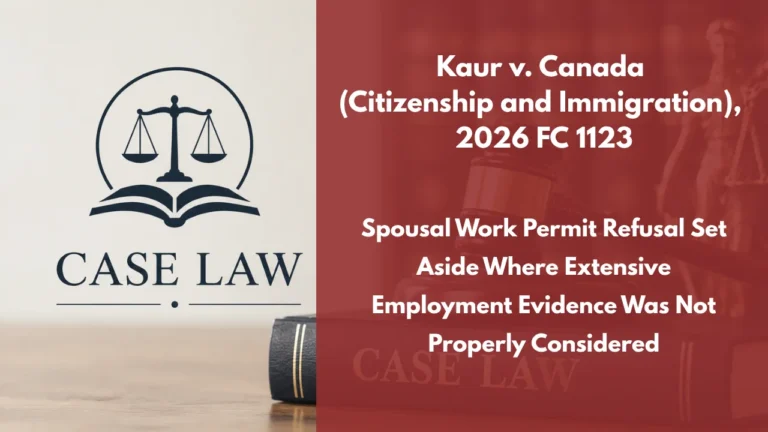
The Federal Court granted judicial review of the refusal of
the Principal Applicant’s spousal work permit application and the study permit
applications of her dependent children. The Officer found insufficient evidence
establishing the spouse’s Canadian employment in a qualifying TEER category.
The Court found this conclusion unreasonable because it was inconsistent with
the extensive documentary evidence before the Officer.
Key Principle
An immigration officer must meaningfully engage with
material evidence that directly contradicts a finding central to the refusal.
Where the record contains substantial and specific evidence supporting an
eligibility requirement, the Officer cannot characterize the evidence as
insufficient without explaining why it does not establish the requirement.
Concerns about one piece of evidence cannot outweigh extensive corroborating
evidence without an explicit and justified finding.
Background
The Principal Applicant applied for a spousal work permit,
while her dependent children applied for study permits. The work permit
application depended on establishing that her spouse was employed in Canada in
an eligible TEER category. The Officer found that there was insufficient
information regarding the spouse’s Canadian employment.
The application contained extensive evidence, including a
valid closed work permit identifying the spouse’s position and TEER category,
an employment verification letter confirming his employment, position, salary
and duties, a positive LMIA, an employment contract, paycheques, and bank
statements showing payments from his employer.
Court Findings
• Extensive Employment Evidence Was Ignored: The
Court held that the evidence could not be characterized as “superficial or
peripheral” to the merits of the application. Collectively, the documents
pointed toward a conclusion different from the Officer’s finding of
insufficiency. The Officer was therefore required to mention and analyze that
evidence.
• Bank Deposit Concern Was Insufficiently Explained: The Officer noted that the bank records appeared to show inconsistencies in the
regularity of deposits from the employer. However, the Court found it unclear
how this concern supported the conclusion that the overall employment evidence
was insufficient.
• Concern Did Not Overcome Corroborating Evidence: Importantly, the Officer did not question the authenticity or veracity of the
employment payments appearing in the bank statements. In light of the closed
work permit, employer letter, LMIA, employment contract, paycheques and bank
records, the concern about deposit regularity could not reasonably outweigh the
other evidence without an explicit finding explaining why.
• Logical Chain of Reasoning Was Missing: The Court
found that the Officer’s unexplained treatment of the bank statements made the
role of that concern in the refusal impossible to understand. Under Vavilov,
the reasons must provide an intelligible and justified chain of reasoning
connecting the evidence to the decision.
Outcome
The Court found the refusal unreasonable and granted
judicial review. The refusals of the work and study permits were set aside and
the applications were remitted to a different Officer for redetermination. The
Court did not address the procedural fairness arguments because the
unreasonableness finding was sufficient. No question was certified and there
was no order regarding costs.
Key Takeaway: Kaur confirms that an officer
must meaningfully address substantial evidence supporting eligibility. Where
multiple documents corroborate Canadian employment, an unexplained concern
about the regularity of bank deposits cannot, by itself, justify an “insufficient
evidence” finding.
Case Citation:
Kaur v. Canada (Citizenship and Immigration), 2026 FC 1123 (CanLII)
Prepared by:
Dr. Muhammad
Abrar (Barrister and
Solicitor)
Author | Writer | Mentor | Legal Researcher | Canadian
Immigration Case Law and Statistics Analyst