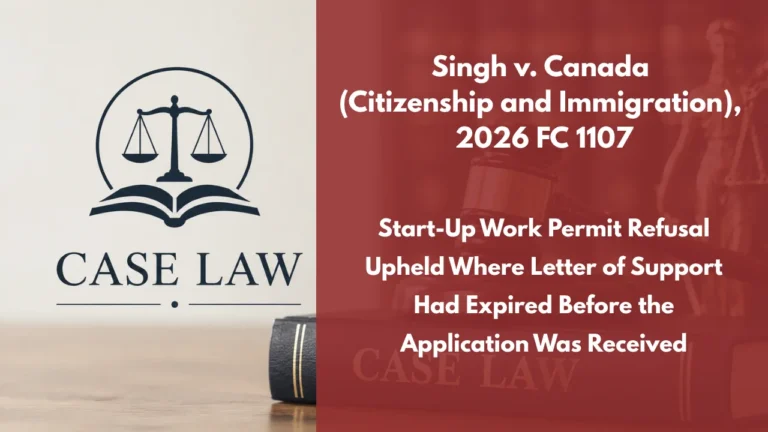
The Applicant sought judicial review of an IRCC Officer’s
refusal of his labour market impact assessment-exempt work permit application
under the Start-Up Business Class Program. The principal issue was whether the
Officer reasonably refused the application because the Applicant’s Letter of
Support had expired before IRCC received the work permit application. The
Federal Court dismissed the application, finding that a valid Letter of Support
was a mandatory eligibility requirement and that the Applicant’s continued
support from the designated entity did not cure the expired document.
Key Principle
Under the Start-Up Business Class work permit requirements,
a Letter of Support issued by a designated entity must be valid when IRCC
receives the work permit application. Continued support from the designated
entity, or the fact that a Letter of Support was valid when an earlier
application was submitted, does not satisfy this requirement. The applicant
bears the onus of providing the required documentation in the form prescribed
by the Program.
Background
The Applicant received a Letter of Support from Biomedical
Commercialization Canada Inc., operating as Manitoba Technology Accelerator
(MTA), dated September 1, 2023. The Letter of Support expired on March 1, 2024.
The Applicant initially submitted a work permit application on January 30,
2024, while the Letter of Support was still valid, but that application was
refused on August 16, 2024. Rather than seeking judicial review of that
refusal, the Applicant submitted a new work permit application on September 26,
2024.
The second application included the expired Letter of
Support and a supplemental letter from MTA dated September 25, 2024, confirming
its continued support of the Applicant and his company. The Officer
nevertheless refused the application, including on the basis that the Letter of
Support had expired before the second application was received.
Court Findings
• Validity at time of application: The Court found no
dispute that the Letter of Support was expired when the second work permit
application was submitted. The applicable Guidelines expressly required the
Letter of Support to be valid when the work permit application was received.
The Officer therefore reasonably concluded that the Applicant did not meet the
eligibility requirement.
• Earlier application did not preserve validity: The
Applicant argued that the Letter of Support had been valid when he filed his
first application. The Court rejected this argument. The Officer was required
to assess the current application against the applicable requirements and was
not required to consider the circumstances of the earlier unsuccessful
application when determining whether the current application satisfied the
Program requirements.
• Continued support was insufficient: The Court
accepted that MTA continued to support the Applicant when the second
application was filed. However, the supplemental letter was not a Letter of
Support in the form required by IRCC. Continued support could not replace the
mandatory document required by the Program. The Applicant bore the
responsibility of submitting the required documentation in the prescribed form.
• Sufficient independent ground: Because the expired
Letter of Support independently justified refusal, the Court found it
unnecessary to consider the Applicant’s arguments concerning the Officer’s
other grounds of refusal.
Outcome
The Federal Court dismissed the application for judicial
review and upheld the work permit refusal. No question was certified.
Case Citation:
Singh v. Canada (Citizenship and Immigration), 2026 FC
1107 (CanLII)
Prepared by:
Dr. Muhammad
Abrar (Barrister and
Solicitor)
Author | Writer | Mentor | Legal Researcher | Canadian
Immigration Case Law and Statistics Analyst