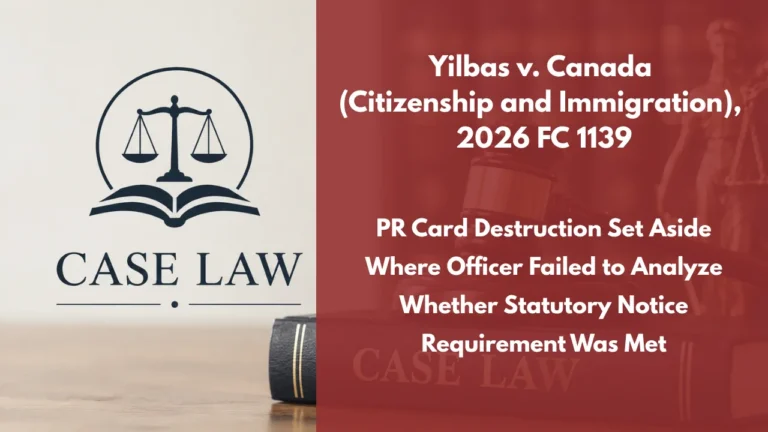
The Federal Court granted judicial review of an Officer’s
decision to destroy the Applicant’s permanent resident card under IRPR 58(3).
The PR Card had been mailed to the address provided in the application but was
returned to IRCC as undeliverable. The Officer subsequently destroyed the card
after more than 180 days had passed without a new Canadian address. The Court
found the decision unreasonable because the Officer did not explain how the
statutory notice requirement under s 58(3) had been satisfied when the Officer
knew the card had not been received.
Key Principle
Where an administrative decision relies on a statutory
precondition, the decision-maker must provide an intelligible analysis
demonstrating that the precondition has been satisfied. Under Vavilov,
the reasons must establish a rational and transparent chain of reasoning. Where
the record shows that statutory notice was apparently not received, an Officer
cannot simply rely on the passage of 180 days without addressing whether the
required notice was actually provided in the circumstances.
Background
The Applicant, a citizen of Turkey, applied to renew his PR
Card on April 4, 2023. IRCC authorized the application on July 24, 2023 and
mailed the PR Card to the Canadian address provided in the application.
However, the card was returned to IRCC as undeliverable on August 17, 2023. On
April 29, 2024, IRCC destroyed the PR Card.
The GCMS note stated that the card had been returned as
undeliverable and that the Applicant had not provided a new or alternative
Canadian address for more than 180 days. The Respondent relied on IRPR 58(3),
which provides that a PR Card may be destroyed if a permanent resident fails to
attend within 180 days after the Department first mails a notice specifying the
time and place for delivery.
Court Findings
• Statutory Notice Requirement Was Not Analyzed: The
Court did not definitively decide whether mailing the PR Card to the address
supplied by the Applicant constitutes the “notice” contemplated by s 58(3).
Instead, it found a narrower reviewable error: the Officer failed to analyze
whether the notice requirement had been satisfied when the card had actually
been returned as undeliverable.
• Officer Knew the Card Had Not Been Received: The
GCMS record expressly showed that the PR Card had been returned to IRCC as
undeliverable. Since the Officer was aware that the communication had not
reached the Applicant, the Court found it unclear how the Officer concluded
that the statutory notice requirement had nevertheless been met.
• Court Declined to Resolve Broader Interpretation: The Court expressly left open whether IRCC’s practice of mailing PR Cards,
rather than sending correspondence requiring attendance at a specified time and
place, satisfies s 58(3). The issue was not sufficiently briefed and argued to
warrant a definitive ruling in this case.
• PR Card Is Evidence of Status, Not Status Itself: The Court rejected the Applicant’s request that the redetermination be based on
his PR status or eligibility as it existed when the original card was issued.
Possession of a PR Card does not itself determine or restore PR status. The
Court therefore left any determination of current PR status to the appropriate
process.
Outcome
The Court found the decision unintelligible and unreasonable
because the Officer failed to explain how the s 58(3) notice requirement was
satisfied despite knowing that the PR Card had been returned as undeliverable.
The decision was set aside and the matter was remitted to a different IRCC
officer to determine whether to issue a PR Card. No question was certified.
Key Takeaway: Yilbas confirms that where IRCC
relies on IRPR 58(3) to destroy a PR Card, the Officer must meaningfully
address whether the statutory notice requirement was satisfied. The mere
passage of 180 days is insufficient where the record shows that the mailed PR
Card was returned as undeliverable and the Applicant apparently did not receive
it.
Case Citation:
Yilbas v. Canada (Citizenship and Immigration), 2026 FC
1139 (CanLII)
Prepared by:
Dr. Muhammad
Abrar (Barrister and
Solicitor)
Author | Writer | Mentor | Legal Researcher | Canadian
Immigration Case Law and Statistics Analyst