The Federal Court dismissed judicial review of a permanent
residence refusal under the Start-Up Business Class where the Applicant was
found inadmissible for misrepresentation under paragraph 40(1)(a) of the Immigration
and Refugee Protection Act (IRPA). The Applicant argued that the procedural
fairness letter did not provide sufficient particulars concerning the alleged
use of an undeclared representative and that the officer failed to properly
consider his denial. The Court found both the process and the officer’s
decision reasonable.
Key Principle
A procedural fairness letter concerning an alleged
undeclared representative must provide enough information to allow the
applicant to understand and respond to the concern. However, where the alleged
use of a representative is a matter within the applicant’s own knowledge, the
officer may satisfy procedural fairness without disclosing protected
information from other applicants or the extrinsic evidence underlying the
concern. A clear denial may be considered but rejected where the officer
identifies documentary evidence supporting the misrepresentation finding.
Background
The Applicant applied for permanent residence under the
Start-Up Business Class in February 2021. In December 2024, the officer raised
concerns about his business plan, including the lack of clarity concerning
revenue generation and the apparent lack of progress or seriousness of the
proposed business. The Applicant subsequently retained Atlantic 724, an
immigration and business consultancy, to respond to the concerns.
The officer later issued a second procedural fairness letter
alleging that the Applicant had used an undeclared representative to facilitate
the submission of his application, contrary to the applicable regulatory
requirements. The letter referred to evidence that the application had been
facilitated by the same person or entity as many other applications received by
the office.
The Applicant responded with an affidavit denying that he
had used a representative before receiving the procedural fairness letter. The
officer nevertheless refused the application and found him inadmissible for
misrepresentation under paragraph 40(1)(a) of IRPA.
Court Findings
• Procedural fairness was satisfied: The Court
recognized that misrepresentation findings attract a higher level of procedural
fairness because of the five-year bar on reapplying. However, the procedural
fairness letter gave the Applicant sufficient information to understand the
concern and provide a meaningful response.
• No obligation to disclose protected information: The Court relied on Brefo, where similarly worded concerns about an
undeclared representative were found sufficient. Information from other
applications was protected and did not have to be disclosed where it was
unnecessary for the Applicant to understand the case he had to meet.
• The affidavit was considered: The GCMS notes
demonstrated that the officer was aware of the Applicant’s denial and his
assertion that he had not knowingly participated in misrepresentation. The
officer ultimately found the affidavit unconvincing.
• Documentary evidence supported the finding: The
officer relied on a payment receipt, contact information, metadata showing that
documents signed by the Applicant had been prepared by others, open-source
research concerning the consultancy, and comparisons with applications prepared
by the same firm. The Court found the reasons transparent and the conclusion
within the range of acceptable outcomes.
Outcome
The application for judicial review was dismissed.
The Court found that the procedural process was fair and that the
misrepresentation finding was reasonable. No question was certified for appeal.
Case Citation:
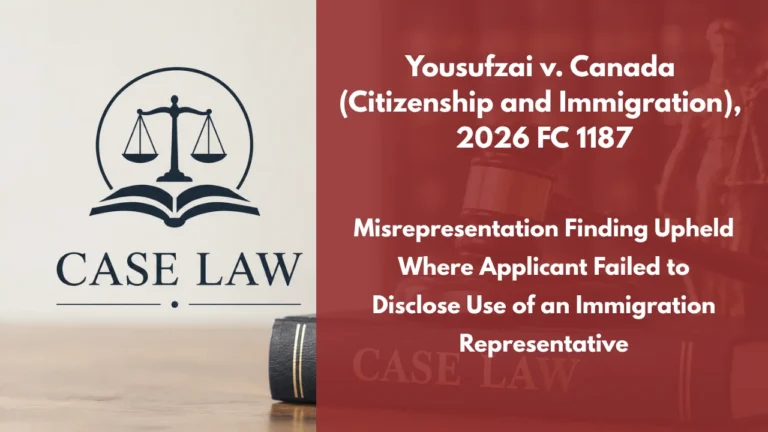
Yousufzai v. Canada (Citizenship and Immigration), 2026 FC 1187 (CanLII)
Prepared by:
Dr. Muhammad
Abrar (Barrister and
Solicitor)
Author | Writer | Mentor | Legal Researcher | Canadian
Immigration Case Law and Statistics Analyst