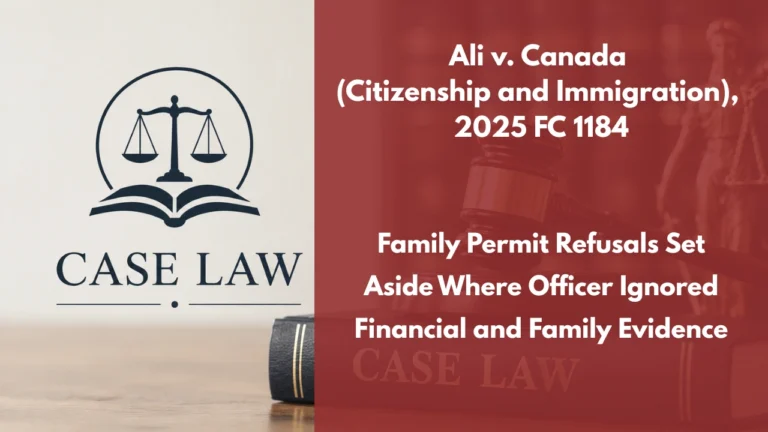
The Federal Court reviewed two IRCC decisions concerning
Hafiza Aroosa Ali and her three children. The first refused Ms. Ali’s spousal
open work permit and the children’s study permit and visitor visa applications.
A later decision refused reconsideration. The Court granted judicial review of
the original refusal because the officer failed to engage with evidence about
the family’s financial establishment and ties to Pakistan. The challenge to the
reconsideration decision was dismissed as late.
Key Principle
Immigration officers must assess the evidence submitted and
respond to material evidence contradicting their conclusions. A decision is
unreasonable where the officer focuses on missing information while ignoring
positive evidence of assets, family ties, and establishment. Arguments advanced
later by the Minister cannot replace reasoning absent from the decision.
Judicial review applications must also be filed within the statutory deadline
unless an extension is obtained.
Background
Ms. Ali, a citizen of Pakistan, sought an open work permit
to join her husband, whose employer-specific work permit allowed him to work in
Canada as a sales supervisor. Their three children applied for study permits
and a visitor visa.
The officer refused the applications on March 18, 2024. The
GCMS notes stated that Ms. Ali’s spouse was in Canada, travelling with the
children would increase their Canadian ties, and their ties to Pakistan would
be reduced. The officer also found that she was not financially established and
had limited employment possibilities in Pakistan.
Ms. Ali requested reconsideration through her Member of
Parliament without submitting new evidence. A second officer refused the
request on March 25, 2024, finding no reviewable error.
Court Findings
• Financial Establishment Evidence Was Ignored
The Court found that the first officer did not address
evidence that Ms. Ali owned assets in Pakistan worth approximately CAD $15,000
and expected to inherit land valued at about CAD $31 million. The officer
focused on her lack of employment experience without assessing evidence
supporting financial establishment.
• Family Ties to Pakistan Were Overlooked
The officer concluded that the applicants’ ties to Pakistan
would be weakened but did not mention the Family Information Form showing that
two of Ms. Ali’s siblings remained there. This evidence supported their return.
• Post Hoc Explanations Could Not Cure the Decision
The Minister argued that Ms. Ali had no employment prospects
in Pakistan and had not shown why her assets or relatives would compel her
return. The Court held that these explanations did not appear in the officer’s
reasons and could not be added afterward.
• Reconsideration Challenge Was Untimely
The reconsideration decision was communicated to the Member
of Parliament on March 25, 2024. The applicants did not prove that they learned
of it later and did not seek an extension. Judicial review of that decision was
therefore dismissed.
Outcome
The Federal Court granted judicial review of the March 18,
2024 refusal and returned the family’s applications to a different officer for
redetermination. Judicial review of the March 25, 2024 reconsideration decision
was dismissed as untimely. No question was certified.
Case Citation:
Ali v. Canada (Citizenship and Immigration), 2025 FC 1184 (CanLII)
Prepared by:
Dr. Muhammad Abrar (Barrister and Solicitor)
Author | Writer | Mentor | Legal Researcher | Canadian Immigration Case Law and Statistics Analyst