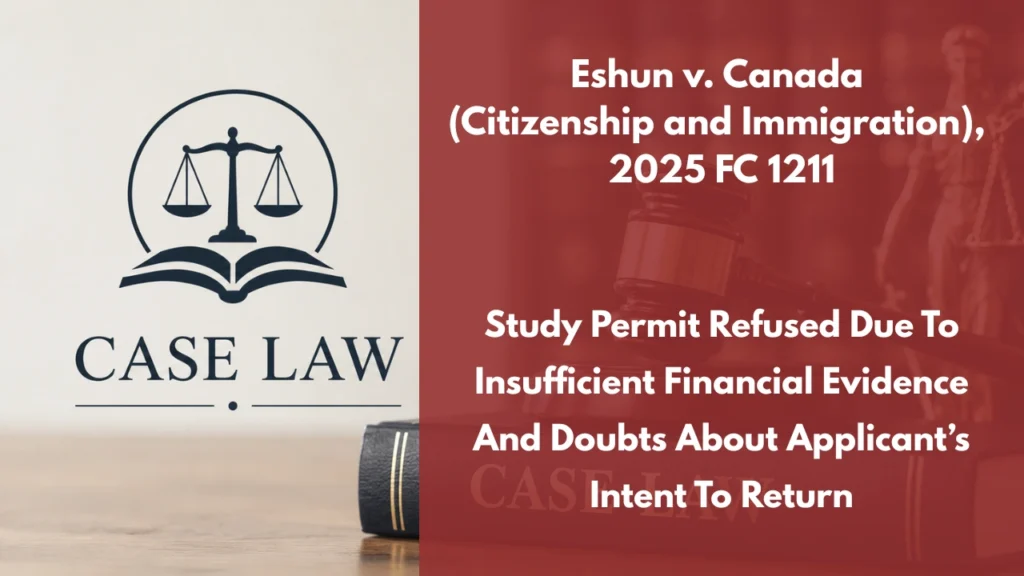
The Federal Court reviewed IRCC’s refusal of Edward Eshun’s
study permit application. The Ghanaian applicant had been admitted to a
one-year post-graduate certificate program in Supply Chain Management –
Logistics at Centennial College. The officer refused the application because
his finances were considered insufficient and the officer was not satisfied he
would leave Canada after his studies. The Court granted judicial review,
finding that the officer failed to address evidence about sponsorship, available
funds, and the applicant’s reasons for returning to Ghana.
Key Principle
Study permit decisions may be concise, but they must respond
to important evidence that contradicts the officer’s conclusions. Where an
applicant provides sworn sponsorship declarations, bank records, employment
evidence, and a return plan, an officer must explain why that evidence is
insufficient. A statement that facts are “not fully supported” does not satisfy
the requirement of justification, transparency, and intelligibility.
Background
The applicant was accepted into a program costing
approximately CAD $42,075, including tuition and living expenses. He stated
that his uncle, Kwadwo Asante, would fully finance his studies and that
approximately CAD $303,153 was available.
The application included two sworn declarations from Mr.
Asante confirming that he was the applicant’s uncle, explaining their
relationship, and committing to fund his education. Bank statements showed
substantial funds in Mr. Asante’s account.
The applicant also submitted a study plan explaining that he
intended to return to Ghana to pursue leadership and business opportunities,
support his parents, and help revitalize his father’s company. An education
leave letter confirmed that he was expected to return to his job after the
program.
The officer nevertheless found that the relationship with
the sponsor was not sufficiently documented, that there was little evidence of
prior financial support, and that the applicant had not shown access to the
funds.
Court Findings
• Sponsorship Evidence Was Not Meaningfully Considered
The Court found that the officer did not explain why the
sworn declarations and bank records were inadequate. The record contained no
evidence suggesting that Mr. Asante was not the applicant’s uncle or that the
promised funds would be unavailable.
• Prior Financial Support Was Not Required
The officer relied on the absence of a history of ongoing
financial support. The Court found no explanation for why past support was
necessary to establish present access to funds.
• Return-to-Ghana Evidence Was Ignored
The officer did not address the study plan, employment
commitments, or education leave letter. These documents directly supported the
applicant’s intention to return to Ghana and resume his career.
• Visa Office Instructions Could Not Cure the Reasons
The Minister argued that the applicant failed to provide a
birth certificate required by regional instructions. The Court found that the
instructions appeared to post-date the application and were not mentioned by
the officer. They could not supplement the decision afterward.
Outcome
The Federal Court granted judicial review, set aside the
July 10, 2024 refusal, and returned the study permit application to a different
IRCC officer for redetermination. No costs were awarded.
Case Citation:
Eshun v. Canada (Citizenship and Immigration), 2025 FC 1211 (CanLII)
Prepared by:
Dr. Muhammad Abrar (Barrister and Solicitor)
Author | Writer | Mentor | Legal Researcher | Canadian Immigration Case Law and Statistics Analyst