Introduction
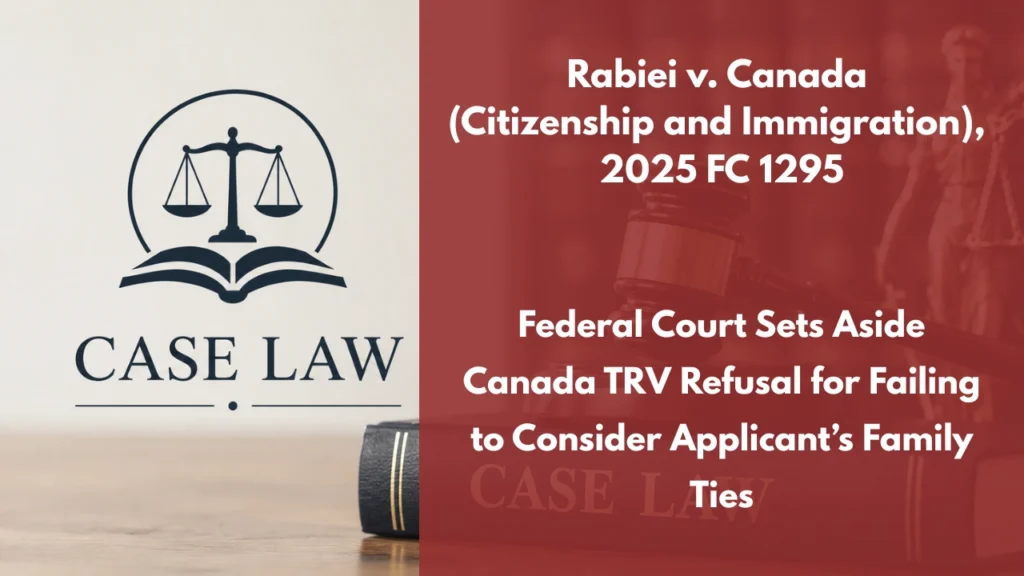
The Federal Court reviewed IRCC’s refusal of Setareh
Rabiei’s temporary resident visa application. The applicant, a citizen of Iran,
sought to visit her husband, who was living and working in Canada on a work
permit. The officer refused the application because her finances were
considered insufficient and she was said to lack significant family ties
outside Canada. The Court granted judicial review, finding that the family-ties
assessment ignored evidence and relied on boilerplate reasoning.
Key Principle
Visa officers must meaningfully assess the evidence before
them, even when providing brief reasons. A statement that an applicant lacks
significant family ties outside Canada is unreasonable where the record
identifies close relatives abroad and the officer does not explain why those
relationships are insufficient. Courts cannot supply missing reasoning or
accept explanations advanced later by the Minister.
Background
The applicant applied for a visitor visa to spend time with
her husband in Canada. Her Family Information Form identified her parents and
siblings, all of whom remained in Iran and would not accompany her.
The officer gave relatively detailed reasons about the
applicant’s and her husband’s financial circumstances. However, the Global Case
Management System notes stated only that the applicant did not have significant
family ties outside Canada.
The applicant argued that this conclusion contradicted her
documentary evidence and showed no meaningful engagement with her
circumstances. The Minister responded that the husband was likely her strongest
family connection and that his presence in Canada weakened her ties to Iran.
Court Findings
• Boilerplate Statement Was Insufficient
The Court found that the officer’s single sentence about
family ties did not address the applicant’s parents and siblings in Iran. The
reasons failed to resolve the conflict between the evidence and the conclusion.
• Spouse Was Not Automatically the Strongest Tie
Justice Go rejected the argument that a spouse must always
be treated as a person’s closest family connection. Family relationships differ
across cultures and individual circumstances. There was no evidence or legal
authority supporting a universal hierarchy placing spouses above parents or
siblings.
• Court Could Not Supply Missing Reasons
The Minister’s argument that the officer had weighed the
husband’s presence in Canada against the applicant’s relatives in Iran was
speculative. That reasoning did not appear in the decision, and the Court would
not presume it.
Outcome
The Federal Court granted judicial review, set aside the
refusal, and returned the application to a different officer for
redetermination. No question was certified.
Case Citation:
Rabiei v. Canada (Citizenship and Immigration), 2025 FC 1295 (CanLII)
Prepared by:
Dr. Muhammad Abrar (Barrister and Solicitor)
Author | Writer | Mentor | Legal Researcher | Canadian Immigration Case Law and Statistics Analyst