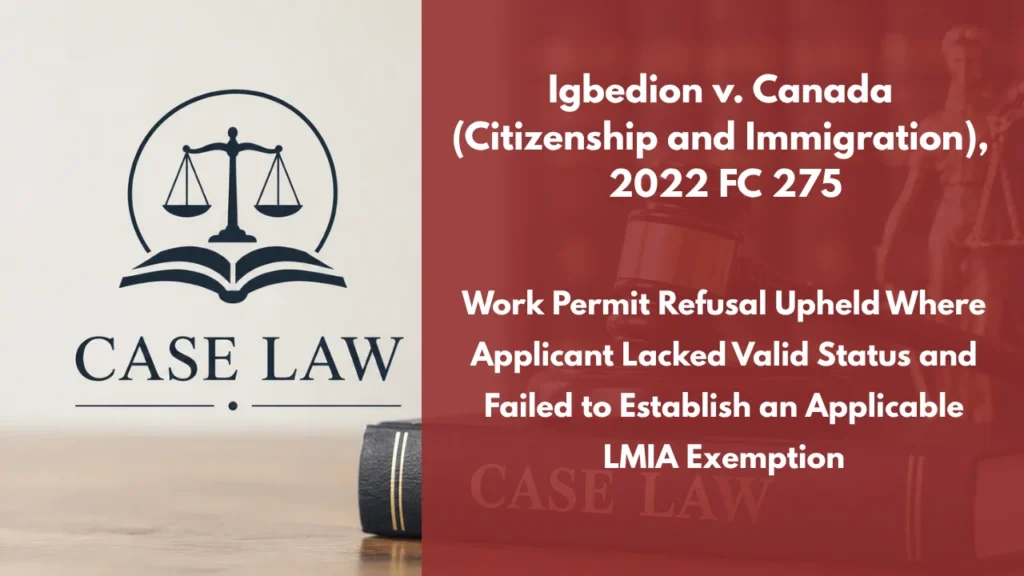
The Federal Court dismissed the
Applicant’s judicial review of a refusal of a work permit application made
under a temporary COVID-19 public policy. The Applicant argued that his
truck-driver position was LMIA-exempt and that the public policy allowed him to
apply from within Canada despite his expired status. The Court found that he
did not satisfy the mandatory eligibility requirements of the policy. Pasted
text
Key Principle
Where a public policy requires an
applicant to have valid status in Canada and a positive LMIA or an LMIA-exempt
offer of employment, the applicant bears the burden of establishing those
requirements. An unsupported assertion that proposed employment is LMIA-exempt
is insufficient. Further, an applicant cannot rely on maintained or deemed
status where an earlier application has already been refused. Pasted text
Background
The Applicant was a British
citizen who had previously held a work permit under the International
Experience Canada program, which expired on March 14, 2020. He had applied for
an extension before expiry but was advised that he had exhausted the maximum period
permitted under that program. He did not take steps to change his status to
visitor before his work permit expired. Pasted text
The Applicant later applied for
another work permit but that application was refused. On December 31, 2020, he
submitted a further application under a COVID-19 public policy that permitted
certain visitors in Canada with valid job offers to obtain employer-specific
work permits without leaving Canada. He claimed that his proposed truck-driver
position was LMIA-exempt and therefore did not require a positive LMIA. Pasted
text
Court Findings
• LMIA or valid exemption
required: The public policy required an applicant to have either a positive
LMIA or an LMIA-exempt offer of employment. The Applicant provided neither a
positive LMIA nor evidence identifying an applicable LMIA exemption code. The
Court therefore found it reasonable for the Officer to refuse the application
on this basis alone. Pasted text
• Applicant bears the burden: The Court rejected the Applicant’s unsupported assertion that his truck-driver
position was LMIA-exempt. He cited no authority establishing the exemption and
did not identify an applicable exemption code. The Court emphasized that the
Applicant was responsible for demonstrating that he met the policy
requirements. Pasted text
• No valid status: The
public policy also required the Applicant to have valid status in Canada as a
visitor when the application was submitted. His status had expired on March 14,
2020, and his earlier April 2020 application had already been refused on July
3, 2020. Accordingly, he could not rely on that outstanding application to
claim deemed status on December 31, 2020. Pasted text
• No procedural fairness
breach: The Court rejected the argument that the Officer was required to
warn the Applicant about deficiencies such as the absence of an LMIA or the
need for restoration. Visa applicants are generally entitled only to a limited
degree of procedural fairness, and officers are not required to advise
applicants of deficiencies or provide an opportunity to cure them. Pasted text
Outcome
The Federal Court dismissed the
application for judicial review. The refusal of the work permit remained in
place, and no question was certified.
Case
Citation:
Igbedion v. Canada (Citizenship and Immigration), 2022 FC 275 (CanLII)
Prepared by:
Dr. Muhammad
Abrar (Barrister and
Solicitor)
Author | Writer | Mentor | Legal Researcher | Canadian
Immigration Case Law and Statistics Analyst