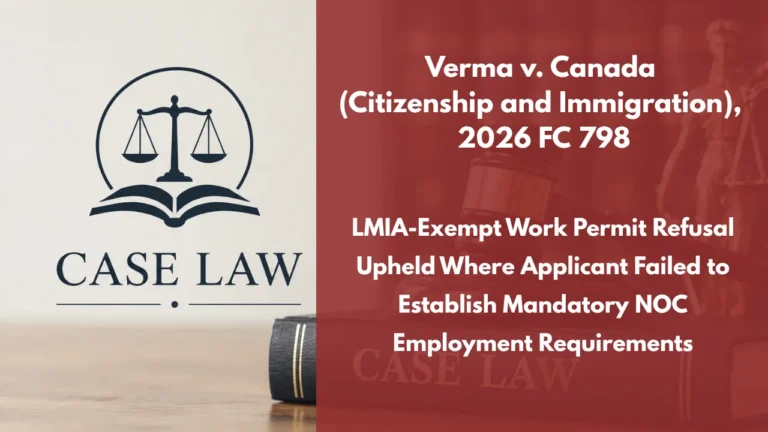
The Federal Court dismissed the
Applicant’s judicial review of a refusal of an LMIA-exempt work permit and
restoration of status. The Applicant sought authorization to work as a food
service supervisor under NOC 62020. The Officer found that the Applicant had
not provided sufficient evidence establishing that he met the mandatory
employment requirements for the occupation.
Key Principle
Where a NOC identifies an
employment requirement as “required,” rather than “usually required,” an
officer may reasonably treat that requirement as a mandatory condition for
issuance of the work permit. An applicant must provide evidence demonstrating
compliance with that requirement. Experience that falls materially short of the
NOC requirement does not establish eligibility merely because the prospective
employer wishes to re-employ the applicant.
Background
The Applicant applied for an
LMIA-exempt work permit to work as a food service supervisor under NOC 62020.
The NOC requires either completion of a community college program in food
service administration, hotel and restaurant management, or a related discipline, or several years of experience in food preparation or service.
Completion of secondary school is described as “usually required.”
The Applicant did not provide
evidence of completing a qualifying educational program or several years of
relevant work experience. Although his application referred to a post-graduate
diploma from Conestoga College, it did not identify the field of study. He
provided evidence that he had worked for approximately one year as an assistant
manager with his prospective employer.
Because he was out of status when
he applied, he also sought restoration of status. Both applications were
refused.
Court Findings
• Mandatory NOC requirement: The Court distinguished between requirements described as “required” and those
described as “usually required.” Relying on Guitang v Canada (Citizenship
and Immigration), 2025 FC 835, the Court held that the requirement for the
NOC at issue was unqualified and could reasonably be treated by the Officer as
a condition precedent to issuing the work permit.
• One year of experience was
insufficient: The Officer expressly considered the Applicant’s employment
history with the prospective employer but reasonably concluded that one year of
experience did not satisfy the NOC requirement of “several years” of
relevant experience.
• Evidence was not ignored: The Court rejected the argument that the Officer overlooked the Applicant’s
previous employment. The GCMS notes specifically referred to the employment
history. The problem was not that the evidence was ignored, but that the
evidence did not establish the mandatory NOC requirement.
• Reasonable chain of
analysis: The Officer identified the applicable NOC requirement, compared
it against the evidence submitted, and concluded that the Applicant had not
established that he could perform the proposed work. The Court found this
reasoning to be intelligible, transparent, and justified under the Vavilov reasonableness framework.
Outcome
The Federal Court dismissed the
application for judicial review. The refusal of the LMIA-exempt work permit and
restoration application therefore remained in place. No question was certified.
Case
Citation:
Verma v. Canada (Citizenship and Immigration), 2026 FC 798 (CanLII)
Prepared by:
Dr. Muhammad
Abrar (Barrister and
Solicitor)
Author | Writer | Mentor | Legal Researcher | Canadian
Immigration Case Law and Statistics Analyst