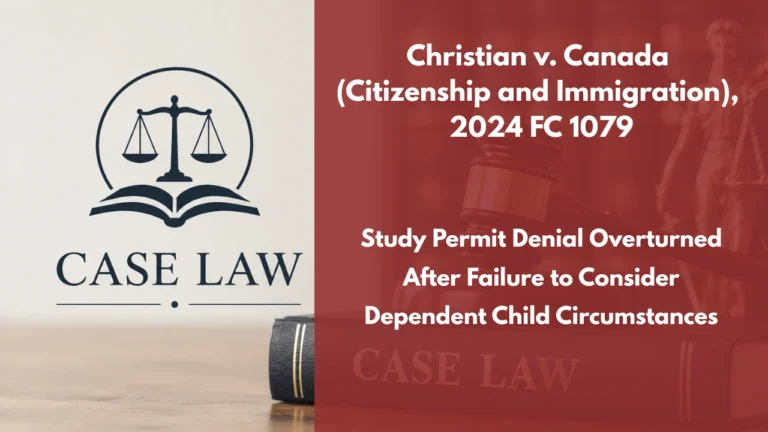
The Federal Court reviewed the
refusal of a 10-year-old child’s study permit application. Both parents already
held valid temporary status in Canada, but the officer found the child’s assets
and financial circumstances insufficient and doubted that he would comply with
temporary residence conditions. The Court granted judicial review because the
analysis was disconnected from the child’s dependency on his parents and
contradicted the evidence.
Key Principle
A minor child seeking to live
with parents who already hold valid status must not be assessed as though
independently responsible for tuition, housing, and living expenses. The
officer must consider the family’s actual circumstances, including parental resources,
existing accommodation, and minimal schooling costs. A finding that a dependent
child will not respect temporary residence conditions requires transparent
evidence rather than speculation.
Background
The applicant’s mother was
studying and working part-time in Canada, while his father had received a
spousal open work permit. The father postponed travelling after the child’s
application was refused.
The child intended to live with
his mother in her existing apartment and continue elementary school. The
evidence showed approximately $21,000 in savings, substantial part-time income,
and only nominal tuition costs.
Court Findings
• Officer Assessed the Child
as an Independent Adult
Although the GCMS notes
recognized that the applicant was a minor whose parents had status in Canada,
the officer focused on his own establishment and ability to pay expenses. This
approach ignored that a 10-year-old child would necessarily depend on his
parents for housing, support, and financial resources.
• Parents’ Existing
Circumstances Were Not Integrated Into the Analysis
The child would live in an
apartment his mother already rented, meaning no separate accommodation expense
was required. His financial situation could not reasonably be isolated from his
parents’ resources and living arrangements, yet the reasons treated him as
financially separate from them.
• Tuition and Living-Cost
Concerns Contradicted the Evidence
The intended elementary schooling
involved little or no tuition, with the application identifying only a nominal
amount. The officer did not explain how these limited expenses exceeded the
family’s available savings and income or why the financial evidence was
inadequate.
• Minister Could Not Supply
Missing Financial Calculations
At the hearing, the Minister
argued that the family had not specifically allocated the required
living-expense amount to the child. The Court held that this reasoning did not
appear in the GCMS notes and therefore could not be added afterward to support the
refusal.
• Temporary-Intent Finding Was
Speculative
The officer was not satisfied
that the child would comply with temporary residence conditions. However, both
parents had already been approved for temporary status, including findings that
they would leave Canada when required, making it speculative to assume their
dependent child would remain behind.
• Serious Compliance Finding
Required Clear Reasons
A conclusion that an applicant
cannot be trusted to comply with immigration conditions is serious and must be
justified transparently. The reasons provided no rational explanation for
attributing such a risk to a dependent minor whose conduct and departure would
naturally follow his parents.
Outcome
The Federal Court granted
judicial review, set aside the study permit refusal, and returned the
application to a different visa officer for redetermination. No question was
certified.
Case Citation:
Christian v. Canada (Citizenship and Immigration), 2024 FC 1079 (CanLII)
Prepared by:
Dr. Muhammad Abrar (Barrister and Solicitor)
Author | Writer | Mentor | Legal Researcher | Canadian Immigration Case Law and Statistics Analyst