The Federal Court reviewed the
refusal of visitor visa applications submitted by a husband, wife, and their
minor child to visit their adult daughter in Canada. The officer concluded that
they had not demonstrated sufficient funds for the proposed visit because their
bank statements were allegedly outdated. The Court granted judicial review
because the record contained recent statements showing substantial savings and
extensive additional financial evidence that the officer failed to address.
Key Principle
When insufficient funds are the
central basis for refusing a TRV application, the officer must assess the
complete financial record and explain why the available funds are inadequate. A
decision cannot reasonably rely on the age of one statement while overlooking
several recent statements, accessible business funds, tax records, property
ownership, and other evidence of financial establishment. Counsel also cannot
repair deficient reasons by proposing explanations that the officer did not
provide.
Background
The applicants sought visitor
visas to visit their adult daughter, who was a PR. They submitted several bank
statements, income tax records, property documents, and an income tax audit
report relating to their business.
Although one set of statements
was five months old, other recent statements showed substantial savings. The
principal applicant also provided evidence that he operated the relevant
business as a sole proprietorship and could access its funds.
Court Findings
• Recent Bank Statements Were
Overlooked
The officer stated that the
submitted statements were not recent, but this description applied to only one
set of documents. The application also contained several current statements
showing substantial savings, and the reasons did not acknowledge or assess
those balances.
• Financial Conclusion Did Not
Reflect the Record
The finding of insufficient funds
was determinative of the refusal, yet the officer did not identify the required
amount, expected travel costs, or any shortfall. Without comparing the
available resources to the proposed visit, the conclusion lacked a discernible
evidentiary foundation.
• Business Funds Were
Accessible to the Applicants
The Minister initially argued
that some savings belonged to a business and had not been shown to be
personally available. However, the record established that the principal
applicant operated an unincorporated sole proprietorship, meaning the officer
could not simply disregard those funds as inaccessible corporate assets.
• Minister Could Not Add a New
Explanation
The officer did not distinguish
between personal and business statements or express concern about access to the
funds. The Court held that counsel could not bolster the decision by advancing
a financial distinction that did not appear in the officer’s reasons.
• Additional Financial
Evidence Was Ignored
The applicants submitted income
tax statements, property ownership records, and a business income tax audit
report. These materials were relevant to their overall financial establishment
and ability to fund the trip, but none were mentioned or meaningfully assessed.
• Reasons Lacked a Rational
Chain of Analysis
Visa officers may provide brief
reasons, but the affected applicants must still be able to understand how the
evidence led to the refusal. Because the officer overlooked central documents
and offered no meaningful financial analysis, the decision lacked justification,
transparency, and intelligibility.
Outcome
The Federal Court granted
judicial review, set aside the TRV refusal, and returned the applications to a
different decision-maker for redetermination. No question was certified.
Case Citation:
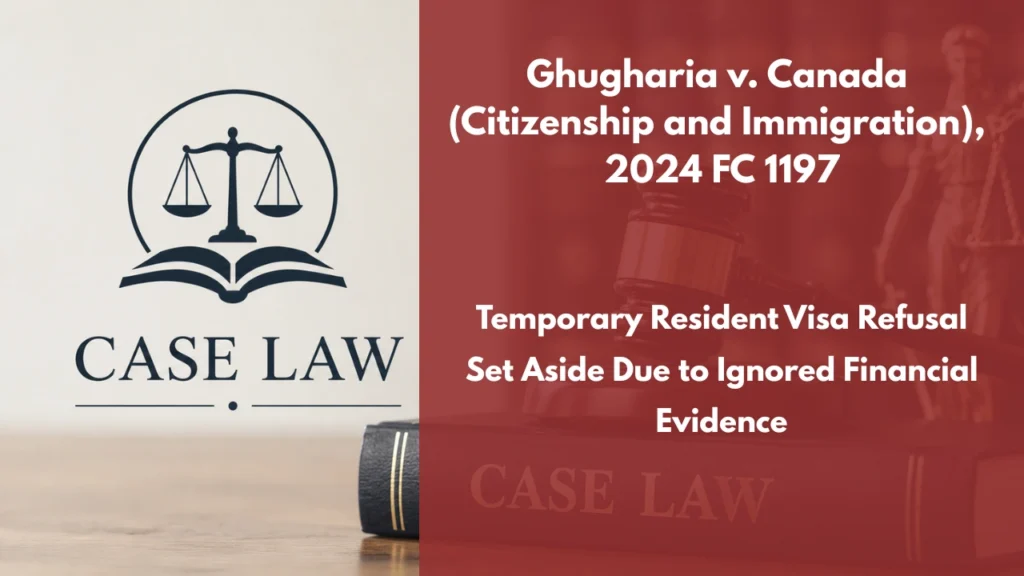
Ghugharia v. Canada (Citizenship and Immigration), 2024 FC 1197 (CanLII)
Prepared by:
Dr. Muhammad Abrar (Barrister and Solicitor)
Author | Writer | Mentor | Legal Researcher | Canadian Immigration Case Law and Statistics Analyst