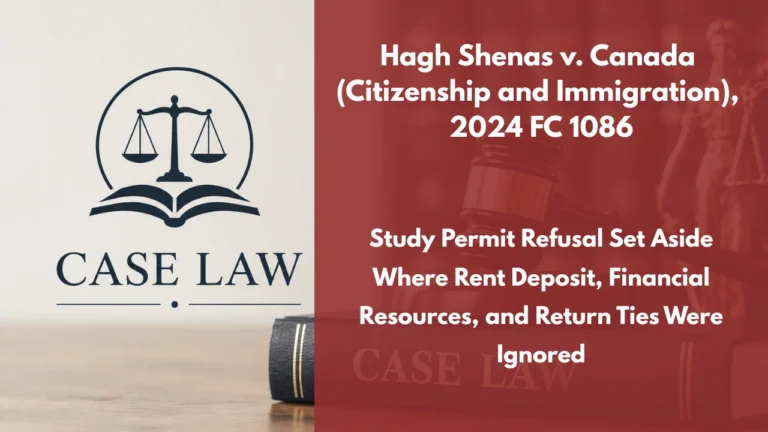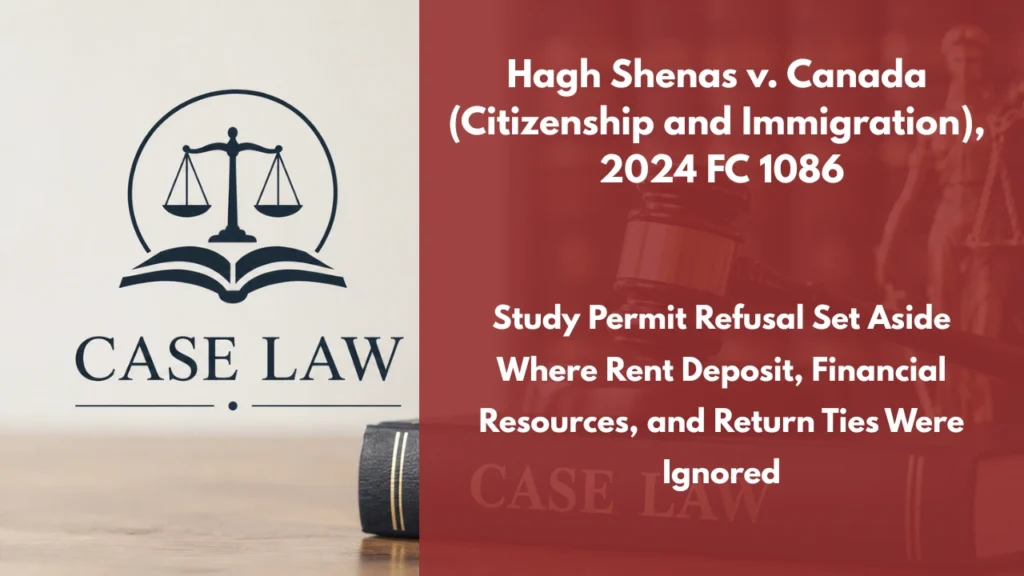
The Federal Court reviewed the
refusal of Fatematossadat Hagh Shenas’s study permit application and the
related work permit and visitor visa applications submitted by her husband and
children. The officer questioned large deposits, found the family’s finances
insufficient, and doubted their temporary intent. The Court granted judicial
review because the officer ignored explanations and evidence directly
addressing these concerns.
Key Principle
A visa officer must assess
financial transactions in light of the applicant’s explanation and supporting
documents. Large deposits cannot reasonably be treated as funds placed
temporarily for an application where the record identifies a legitimate source.
Temporary intent also requires meaningful consideration of employment, family,
community, property, and other return ties. Related family applications cannot
stand where they depend entirely on an unreasonable principal decision.
Background
The principal applicant sought a
two-year business, management, and marketing master’s degree. Her husband
applied for an open work permit, while their children applied for visitor
visas.
The family submitted bank
records, evidence explaining a substantial rent deposit, other financial
accounts, employment documents, property ownership, travel history, and
evidence of continuing connections and job opportunities abroad.
Court Findings
• Large Deposits Were
Improperly Treated as Artificial Funds
The officer suspected that
several substantial deposits had inflated the applicant’s account for
demonstration purposes. However, the application contained evidence showing
that the money represented a rental deposit received for an apartment owned and
leased by the applicant and her husband.
• Explanation for the Source
of Funds Was Ignored
The concern was not merely that
income was unstable, but that the deposited funds were not legitimate
resources. By failing to address the documented rental explanation, the officer
reached a conclusion that directly contradicted the evidence before them.
• Complete Financial Position
Was Not Assessed
The applicant submitted
additional bank accounts, income information, and evidence of funds belonging
to her husband. These resources demonstrated that the family possessed more
than the amount required for at least the first year, but the officer focused
almost exclusively on one account.
• Minister Could Not Supply
New Financial Reasons
The Minister argued that the
funds did not reflect stable income and were inadequate given Canadian living
costs. The Court found that these explanations did not appear in the officer’s
reasons and could not be introduced afterward to repair the deficient analysis.
• Employment Letter Was
Misunderstood
The officer discounted the
employer’s letter because it did not explain why international education was
necessary. The letter’s actual purpose was to demonstrate stable past
employment, promised re-employment, future salary, and a concrete professional
incentive to return after graduation.
• Significant Return Ties Were
Overlooked
The family submitted evidence of
employment opportunities, relatives, friends, community connections,
apartments, a vehicle, and previous travel compliance. The officer did not
meaningfully weigh these factors before concluding that the family would remain
beyond their authorized stay.
Outcome
The Federal Court granted
judicial review, set aside all four temporary residence decisions, and returned
the applications to a different decision-maker for redetermination. No question
was certified.
Case Citation:
Hagh Shenas v. Canada (Citizenship and Immigration), 2024 FC 1086 (CanLII)
Prepared by:
Dr. Muhammad Abrar (Barrister and Solicitor)
Author | Writer | Mentor | Legal Researcher | Canadian Immigration Case Law and Statistics Analyst