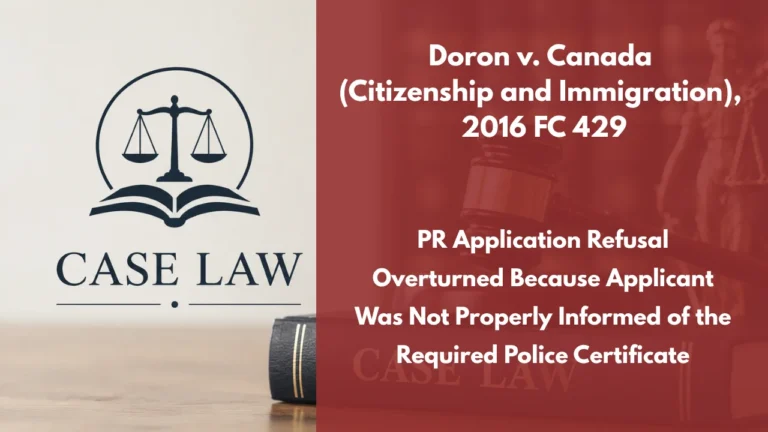
The Federal Court reviewed the refusal of a permanent
residence application under Express Entry because the applicant had submitted a
police certificate from the Philippines issued by the National Police
Commission (NPC), rather than the required certificate from the National Bureau
of Investigation (NBI).
The Court overturned the refusal because the applicant had
not been properly advised that an NBI certificate was specifically required.
Key Principle
Although applicants generally bear the responsibility of
submitting a complete application with the required supporting documents, procedural
fairness may require initial notice of a specific document requirement where the applicant was not actually informed of that requirement.
An officer is generally not required to give applicants
repeated opportunities to correct an incomplete application. However, where the
applicant was never properly advised of the particular requirement that led to
the refusal, the application may be unfairly refused.
Background
The applicant was a Philippine citizen who applied for
permanent residence through Express Entry after receiving an Invitation to
Apply.
He submitted a police certificate issued by the Philippine
National Police Commission. However, CIC required a police certificate issued
by the National Bureau of Investigation.
The applicant had difficulty uploading documents and had
previously informed CIC about difficulties obtaining police certificates from
several countries. His application was ultimately rejected as incomplete
because the required NBI certificate had not been submitted.
The applicant argued that he had not been provided with the
checklist that CIC’s correspondence said would identify the required documents
and that he was unaware that the Philippine certificate had to be issued by the
NBI.
Court Findings
The Federal Court found that the applicant had been denied
procedural fairness.
The Court accepted that there is generally no obligation
on an immigration officer to repeatedly alert an applicant about missing
documents or provide multiple opportunities to complete an application.
However, in this case, the Court found that the applicant
had never been properly advised that the police certificate had to be
specifically issued by the NBI.
CIC had referred the applicant to a document checklist, but the
checklist was never provided to him. The Respondent instead relied on
website screenshots to establish that the applicant had been informed of the
NBI requirement. The Court declined to rely on those screenshots because they
had not been properly introduced into evidence and did not establish that the
applicant had been informed of the requirement at the relevant time.
The Court therefore concluded that CIC had failed to provide
the initial notice of the requirement necessary to satisfy procedural
fairness.
Outcome
The Federal Court allowed the application for judicial
review and returned the matter to another immigration officer for
redetermination, with an opportunity for the applicant to submit the required
police certificate.
Case Citation:
Doron v. Canada (Citizenship and Immigration), 2016 FC 429 CanLII
Written by:
Dr. Muhammad
Abrar (Barrister and
Solicitor)
Author | Writer | Mentor | Legal Researcher | Canadian Immigration Case Law and
Statistics Analyst