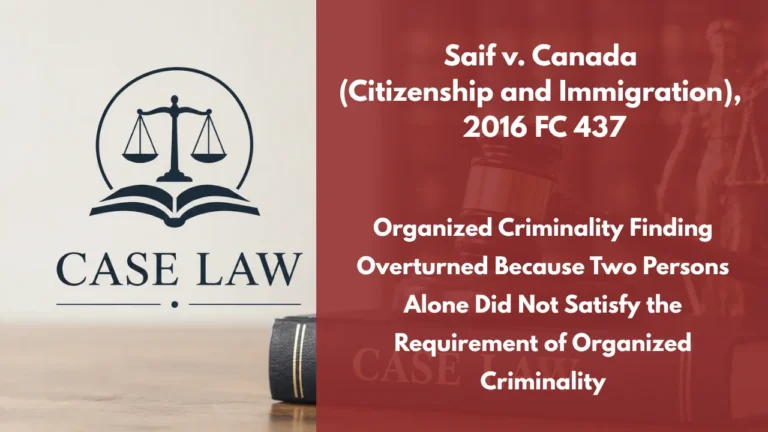
The Federal Court reviewed a finding that the applicant was
inadmissible under paragraph 37(1)(a) of the IRPA for engaging in activity that
formed part of a pattern of criminal activity organized by persons acting
together.
The Court overturned the decision because the Board failed
to properly apply the Supreme Court of Canada’s interpretation of “organized
criminality” and incorrectly treated the applicant’s criminal activity with
one other person as sufficient to establish organized criminality.
Key Principle
A finding of organized criminality under section 37(1)
requires more than evidence that two people acted together in criminal
activity.
The provision requires the existence of organized
criminality, including organizational characteristics such as identity,
leadership, a loose hierarchy, and a basic organizational structure. The
involvement of third parties or customers in related unlawful conduct does not
automatically make those individuals part of the criminal organization.
Background
The applicant pleaded guilty to participating in a scheme
involving fraudulent Canadian residency addresses and documentation for
hundreds of people. His role was secondary to that of the principal organizer.
He allowed his address to be used, assisted with collecting mail and
transporting clients, and received payment.
The Immigration Division found that his activities
constituted organized criminality under paragraph 37(1)(a), relying on the
large number of people involved, the length of the scheme, communications,
planning, and cooperation.
The applicant challenged the finding, arguing that the
evidence did not establish the organized criminality required by section
37(1)(a).
Court Findings
The Federal Court found that the Board had erred in its
application of section 37(1)(a).
The Court held that the Supreme Court’s interpretation of “organized
criminality” in B010 v. Canada applied to both paragraphs 37(1)(a)
and (b). This required consideration of the organizational structure of the
criminal activity.
Although the evidence showed that the applicant and Mr.
El-Akhal had engaged in a long-standing criminal conspiracy, the Court found
that two persons alone could not satisfy the requirement of organized
criminality. The approximately 300 people who benefited from the scheme
could not simply be counted as members of the criminal organization because
they were third parties who participated in individual transactions.
The Court emphasized that an organization may have an
informal structure, but there must still be organizational characteristics such
as leadership, identity, hierarchy, and basic structure. The Board had
failed to apply these principles to the evidence.
Outcome
The Federal Court allowed the application for judicial
review, set aside the inadmissibility decision, and returned the matter to
a different decision-maker for redetermination.
Case Citation:
Saif v. Canada (Citizenship and Immigration), 2016 FC 437 CanLII
Written by:
Dr. Muhammad
Abrar (Barrister and
Solicitor)
Author | Writer | Mentor | Legal Researcher | Canadian Immigration Case Law and
Statistics Analyst