The
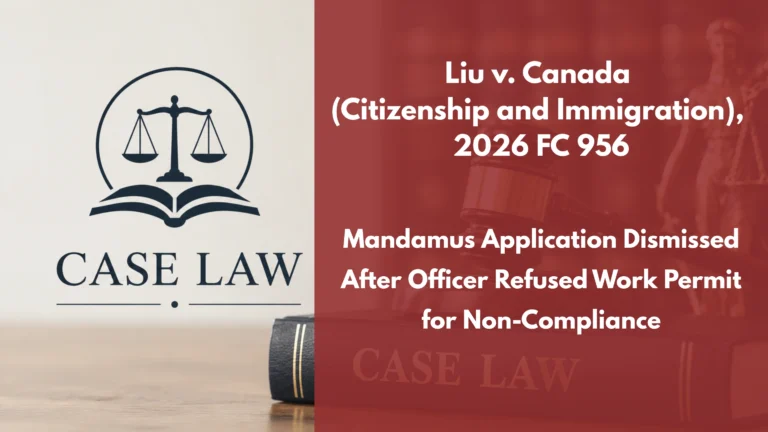
Federal Court dismissed an application for judicial review seeking an order of
mandamus to compel IRCC to decide a work permit application. Although IRCC
issued a decision only after the judicial review had been commenced, the Court
held that the application was not moot because the parties continued to
dispute whether the delay in processing was unreasonable. Nevertheless, the
Court concluded that mandamus was unavailable because IRCC had already
fulfilled its legal duty by rendering a decision before the matter was heard.
The case provides important guidance on the relationship between processing
delays, mootness, and the legal requirements for obtaining mandamus.
Key
Principle
A
judicial review seeking mandamus does not automatically become moot simply
because IRCC issues a decision after litigation has commenced. However, once
IRCC has discharged its legal duty by making a decision, an applicant generally
cannot establish the essential prerequisite for mandamus—namely, a continuing
refusal to perform the statutory duty.
Background
The
applicant applied for a work permit in August 2024 to undertake paid PhD
research at the University of Alberta.
During
processing, IRCC completed the applicant’s security assessment and later
requested updated medical and employment information. When no response was
received, the application was refused for non-compliance under subsections
16(1) and 16(2) of the Immigration and Refugee Protection Act (IRPA).
Before
the refusal was issued, the applicant had already commenced an application for
judicial review seeking an order of mandamus on the basis of unreasonable delay
in processing the work permit application.
Court
Findings
Justice
Battista held that the judicial review was not moot, even though IRCC
had rendered a decision before the hearing.
The
Court explained that the central dispute between the parties was not simply
whether a decision had been made, but whether IRCC had taken an unreasonable
amount of time to process the application. That dispute continued to exist
despite the eventual refusal, and the Court observed that findings regarding
unreasonable delay may still serve useful purposes, including public
accountability or, in appropriate cases, an award of costs.
However,
the Court concluded that the applicant could not satisfy the legal test for mandamus.
Applying
the well-established Apotex test, the Court emphasized that an applicant
must demonstrate a clear right to the performance of a public duty,
including proof that the decision-maker has refused—either expressly or
implicitly—to perform that duty.
In
this case, there was no refusal to act. IRCC had fulfilled its statutory
obligation by issuing a decision on the work permit application before the
judicial review was determined. Since the legal duty had already been
discharged, the applicant could no longer establish a continuing failure to
act, which is an essential prerequisite for mandamus.
Accordingly,
although the Court acknowledged that processing delays may continue to be
scrutinized after a decision is rendered, the remedy of mandamus was no longer
available because the underlying duty had already been performed.
Outcome
The
Federal Court dismissed the application for judicial review and the request for
mandamus. The decision confirms that while a delayed immigration decision does
not necessarily render a mandamus application moot, the issuance of a decision
before the Court determines the matter will generally prevent an applicant from
obtaining mandamus because there is no longer an ongoing refusal by IRCC to
perform its statutory duty.
Case
Citation:
Liu v. Canada (Citizenship and Immigration), 2026 FC 956 (CanLII)
Prepared by:
Dr. Muhammad
Abrar (Barrister and
Solicitor)
Author | Writer | Mentor | Legal Researcher | Canadian
Immigration Case Law and Statistics Analyst