The
Federal Court dismissed an application for judicial review challenging the
refusal of a permanent residence application under the Ontario Immigrant
Nominee Program (OINP). The applicants argued that their former immigration
representative’s incompetence caused them to omit a previously refused visitor
visa from their application, resulting in a finding of misrepresentation. The
Court rejected this argument, holding that the applicants failed to establish
either incompetent representation or that any alleged incompetence caused a
miscarriage of justice. The decision reinforces the principle that applicants
remain responsible for verifying the accuracy and completeness of every
immigration form they sign.
Key
Principle
Applicants
bear the ultimate responsibility for ensuring that the information contained in
their immigration applications is truthful, complete, and accurate. Allegations
of incompetent legal representation will only succeed where the applicant
establishes both genuine incompetence and that the outcome would likely have
been different but for the representative’s conduct.
Background
The
principal applicant applied for permanent residence through the Ontario
Immigrant Nominee Program, including her son as a dependent.
During
processing, IRCC issued three separate Procedural Fairness Letters (PFLs) requesting clarification regarding previous visa refusals, specifically
directing the applicants to disclose any previously refused applications
involving the principal applicant’s son.
Despite
these repeated opportunities, the applicants resubmitted the same Background
Declaration form on three occasions without disclosing that the son had
previously been refused a Canadian visitor visa.
IRCC
ultimately refused the permanent residence application under paragraph 40(1)(a)
of the Immigration and Refugee Protection Act (IRPA) for
misrepresentation.
Before
the Federal Court, the applicants argued that their immigration representative
failed to forward the PFLs properly, failed to explain the disclosure
requirements, and that the application would have been approved had competent
representation been provided.
Court
Findings
Justice
Ahmed dismissed the application.
The
Court reaffirmed the long-standing principle that applicants are generally
bound by the conduct of the representatives they voluntarily retain. Claims of
incompetent representation constitute a narrow exception and require proof of
three elements: (1) incompetence, (2) a resulting miscarriage of justice,
and (3) that the former representative had a reasonable opportunity to respond.
Although
the Court accepted that the former representative had been given an opportunity
to respond, the applicants failed to establish the first two requirements.
The
evidence demonstrated that the applicants personally signed the Background
Declaration forms on three separate occasions, each time certifying that the
information provided was complete, truthful, and accurate. The representative’s
assistant repeatedly instructed the applicants to verify, review, and confirm
the information before signing. Following the third Procedural Fairness Letter,
the assistant even reviewed the form directly with the principal applicant’s
son before it was resubmitted.
The
Court further found no evidence that the representative had ever been informed
about the son’s prior visitor visa refusal. Without proof that the
representative knew of the omitted information, there was no basis for finding
that the representative acted incompetently.
Most
importantly, the Court emphasized that applicants have an independent duty to
review every document they sign. Even if the representative’s communications
could have been clearer, the applicants had multiple opportunities to identify
and correct the omission after receiving repeated requests from IRCC to
disclose all prior visa refusals.
Outcome
The
Federal Court dismissed the application for judicial review, holding that the
applicants failed to establish incompetent representation or procedural
unfairness. The decision serves as an important reminder that applicants cannot
avoid the consequences of inaccurate immigration applications simply by
attributing errors to their representative, particularly where they repeatedly
sign declarations confirming that the information provided is complete and
correct.
Case
Citation:
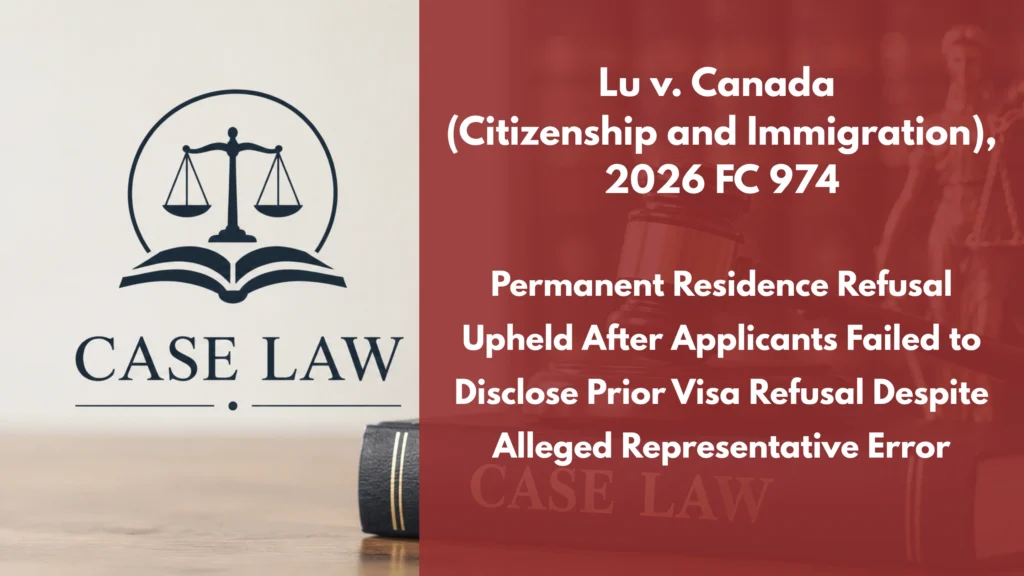
Lu v. Canada (Citizenship and Immigration), 2026 FC 974 (CanLII)
Prepared by:
Dr. Muhammad
Abrar (Barrister and
Solicitor)
Author | Writer | Mentor | Legal Researcher | Canadian
Immigration Case Law and Statistics Analyst