Outcome
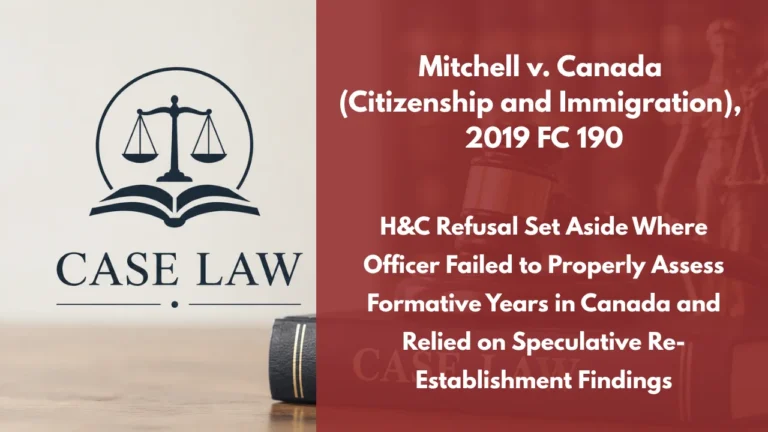
Judicial Review Allowed In Mitchell v. Canada
(Citizenship and Immigration), 2019 FC 190, the Federal Court reviewed the
refusal of an application for permanent residence on humanitarian and
compassionate grounds.
The applicant had been brought to Canada from St. Lucia at
the age of eight and had lived in Canada for more than 15 years. The officer
acknowledged his lengthy residence, education, community ties, and family
connections, but ultimately gave his establishment minimal weight.
The Federal Court found that the officer failed to assess
his circumstances in a manner consistent with the equitable and compassionate
principles set out in Kanthasamy.
Key Principle
An H&C assessment must go beyond simply listing
establishment factors. The officer must consider the human significance of
those circumstances, particularly where an applicant spent their formative
childhood and adolescent years in Canada.
An applicant’s immigration non-compliance remains relevant,
but its nature and severity must be assessed in context. Where a person was
brought to Canada as a child and had no control over becoming out of status,
that history should not be treated in the same manner as deliberate immigration
misconduct.
Further, findings about an applicant’s ability to
re-establish abroad must be grounded in evidence rather than speculation.
Background
The applicant arrived in Canada from St. Lucia at age eight
and remained after his temporary status expired.
He completed primary and secondary school in Toronto,
maintained strong academic standing, participated in sports, volunteered in his
community, attended church, and developed close relationships with family and
community members.
Although he had worked without authorization, he claimed to
be financially self-sufficient and had never received social assistance. He
also submitted that he had little connection to St. Lucia after having spent
most of his childhood and adult life in Canada.
The officer nevertheless gave his Canadian establishment
minimal weight and reasoned that, as a young, educated man with Canadian work
experience, he could likely find employment and gradually establish himself in
St. Lucia.
Court Findings
The Federal Court found that the officer had failed to
adequately consider what 15 years of residence in Canada actually meant for the
applicant.
He had arrived at eight years old and had spent his formative
years in Canada. He grew up in Canada, received his entire meaningful
education here, participated in school and community life, and developed
significant social relationships. The officer listed these factors but did not
meaningfully consider their humanitarian significance.
The Court also criticized the treatment of the applicant’s
unauthorized employment. The officer first gave the work history little weight
because it was insufficiently documented, but then assigned negative weight
because any employment would have been unauthorized. The Court found this
internally inconsistent.
Importantly, the applicant had not chosen to enter or remain
in Canada unlawfully as a child and had later taken steps to regularize his
status. His situation therefore differed from cases involving deliberate
misrepresentation or intentional immigration misconduct.
Finally, the officer’s hardship analysis was speculative.
There was no evidence that family and friends in Canada could financially
support him in St. Lucia or that estranged relatives there would reconnect with
him upon return.
Outcome
The Federal Court allowed the application for judicial
review, set aside the H&C refusal, and returned the matter for
reconsideration by a different officer.
Case
Citation:
Mitchell v. Canada (Citizenship and Immigration), 2019 FC 190 CanLII
Prepared by:
Dr. Muhammad Abrar (Barrister and Solicitor)
Author | Writer | Mentor | Legal Researcher | Canadian Immigration Case Law and Statistics Analyst