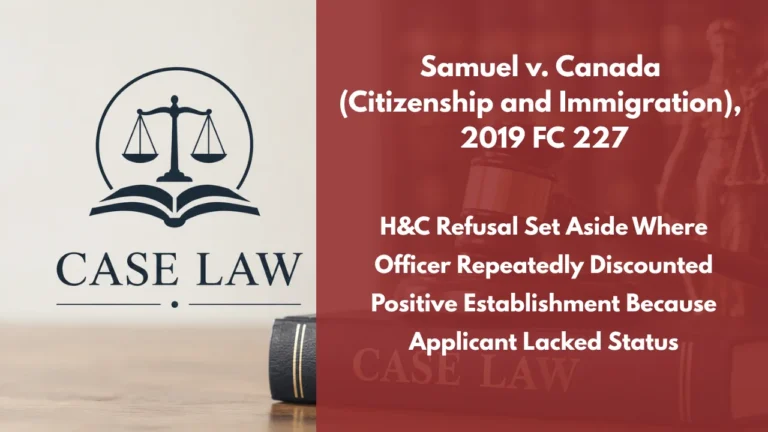
In Samuel v. Canada (Citizenship and Immigration), the
Federal Court reviewed the refusal of an application for permanent residence on
humanitarian and compassionate grounds.
The applicant had lived in Canada for approximately 17 years
without status. Although the officer accepted several positive indicators of
establishment, including continuous employment, community involvement, skills
upgrading, payment of rent, financial support to family abroad, and an absence
of reliance on social assistance, those factors were repeatedly discounted
because of her lack of legal immigration status.
The Federal Court found that approach unreasonable.
Key Principle
An H&C officer may consider an applicant’s failure to
maintain lawful immigration status. However, the officer must balance respect
for Canada’s immigration laws against the reality that section 25 of IRPA
frequently applies precisely to individuals who do not have status.
It is unreasonable to repeatedly diminish otherwise positive
establishment factors simply because they were accumulated while the applicant
was without status.
Background
The applicant, a citizen of St. Vincent and the Grenadines,
entered Canada as a visitor in December 2000 and remained after her status
expired.
She had experienced serious childhood trauma and later
domestic violence in Canada. She eventually separated from her husband
following an assault and restraining order.
Her H&C application relied on several factors, including
domestic violence, establishment in Canada, country conditions, hardship, and
the interests of children in her extended family.
By the time of the application, she had lived in the Greater
Toronto Area for nearly 17 years. She provided evidence that she had
consistently worked as a cleaner, housekeeper, and babysitter, upgraded her
employment skills, paid rent, financially supported relatives in St. Vincent,
and developed extensive social and community ties.
Court Findings
The Court focused primarily on the officer’s treatment of
establishment.
The officer gave little or negative weight to three major
considerations because of the applicant’s lack of lawful status:
- her 17 years of residence in
Canada were greatly discounted;
- her financial establishment was
given minimal weight because she lacked conventional documents such as pay
stubs and tax returns; and
- her continuous employment was
diminished because she had worked without authorization.
The Court found this cumulative treatment unreasonable.
Justice Simpson emphasized that although non-compliance with
immigration law is a legitimate consideration, an H&C decision-maker cannot
allow lack of status to effectively erase the significance of positive
establishment evidence.
This was particularly important because the officer had
accepted evidence that the applicant had worked continuously, upgraded her
skills, received strong employment references, paid rent, never relied on
social assistance, and sent financial support to family members abroad.
The Court also observed that conventional employment
documentation such as pay stubs and income tax records may not ordinarily be
available to persons without status who work in household employment.
The officer therefore placed disproportionate negative
weight on the applicant’s lack of status instead of fairly balancing it against
the evidence of long-term establishment.
Outcome
The Federal Court allowed the application for judicial
review and ordered that the H&C application be reconsidered in
accordance with the Court’s reasons.
Case Citation:
Samuel v. Canada (Citizenship and Immigration), 2019 FC 227 CanLII
Prepared by:
Dr. Muhammad Abrar (Barrister and Solicitor)
Author | Writer | Mentor | Legal Researcher | Canadian Immigration Case Law and Statistics Analyst