Ø Introduction
The Federal Court reviewed an Immigration Appeal Division
(IAD) decision refusing H&C relief in a parent sponsorship appeal where the
sponsor did not meet the applicable minimum necessary income requirements.
The Court upheld the decision, finding that the IAD
reasonably assessed the applicant’s financial circumstances, family ties, and
the best interests of her Canadian-born children.
Ø Key Principle
An IAD conducting an H&C assessment may consider the applicable
law at the time of the appeal, including regulatory changes that occurred
after the original sponsorship application was filed.
A sponsor does not acquire an accrued right to have the
sponsorship determined under the regulations that existed when the application
was submitted.
The applicant also bears the burden of providing sufficient
evidence to establish the H&C circumstances relied upon.
Ø Background
The applicant, a Canadian citizen, sought to sponsor her
parents and three brothers from India. Her sponsorship application was refused
because she did not meet the minimum necessary income requirements.
While her appeal was pending, the regulations changed and
increased the income requirements for parent and grandparent sponsorships. The
IAD notified the applicant of the change and requested updated financial
evidence.
At the IAD hearing, the applicant did not challenge the
validity of the original refusal. The appeal therefore focused on whether
sufficient H&C considerations justified special relief.
The IAD considered the applicant’s financial circumstances,
family size, the financial situation of her parents, the family’s ties to India
and Canada, and the best interests of her three Canadian-born children.
Ø Court Findings
The Federal Court found that the IAD reasonably applied the current
version of the regulations when assessing the appeal.
The Court rejected the argument that the applicant had
acquired a right to have the sponsorship considered under the income
requirements that existed when she filed her application. Until all conditions
necessary to obtain the desired immigration right are fulfilled, an applicant
generally has only potential future rights.
The Court also upheld the IAD’s H&C assessment. The IAD
considered the applicant’s establishment in Canada, her family ties in India,
her financial circumstances, her parents’ assets, and the objective of family
reunification.
Although the IAD’s analysis of the children’s best interests
was not extensive, the Court found that the limited evidence provided by the
applicant restricted what the IAD could reasonably assess. The IAD had
considered the children’s relationship with their grandparents and uncles in
India and gave weight to their interests, but found that the evidence did not
establish sufficient hardship.
The Court also rejected the argument that the IAD improperly
treated family separation as insufficient. The evidence did not demonstrate
unusual or serious circumstances that justified special relief despite the
failure to meet the applicable income requirements.
The Court concluded that the IAD’s decision fell within the
range of reasonable outcomes and that judicial intervention was not warranted.
Ø Outcome
The Federal Court dismissed the application for judicial
review and upheld the IAD’s refusal of H&C relief.
Case Citation:
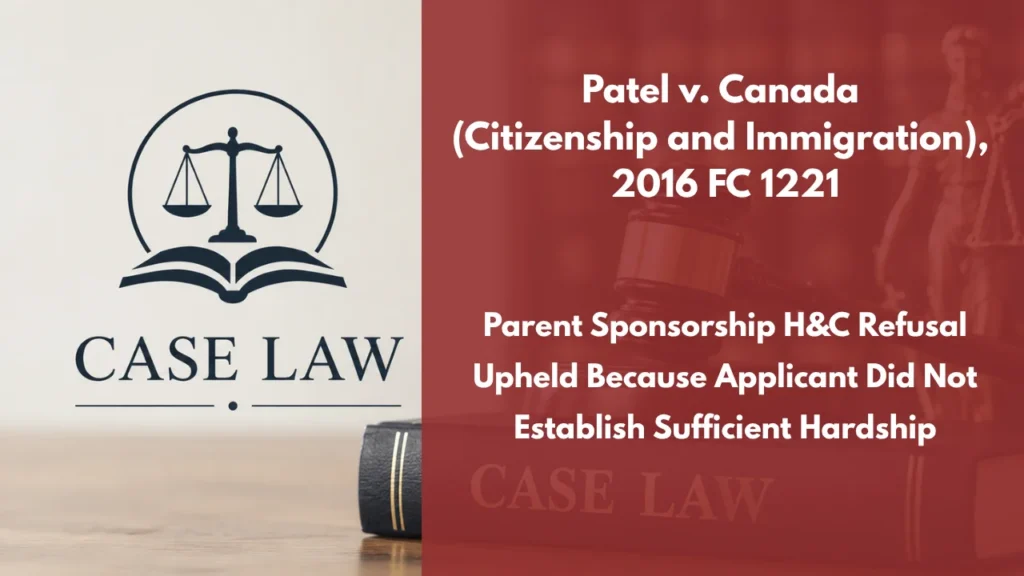
Patel v. Canada (Citizenship and Immigration), 2016 FC 1221 CanLII
Prepared by:
Dr. Muhammad
Abrar (Barrister and
Solicitor)
Author | Writer | Mentor | Legal Researcher | Canadian
Immigration Case Law and Statistics Analyst