Ø Introduction
The Federal Court reviewed the refusal of an H&C
application by a Guyanese mother who had been removed from Canada while her two
children remained in Canada with their maternal grandparents.
The Court upheld the refusal, finding that the officer
properly considered the best interests of both children and was not
required to use formulaic language when conducting the assessment.
Ø Key Principle
An officer conducting a BIOC assessment is not required
to use specific or formulaic wording.
The important question is whether the officer identified the
circumstances relevant to each child and meaningfully assessed their best
interests.
The applicant also bears the burden of providing sufficient
evidence to support the H&C request.
Ø Background
The applicant, a citizen of Guyana, entered Canada in 1999
and had two children while in Canada. Her son was born in 1999 and her daughter
in 2003.
Following her removal from Canada in 2013, both children
remained in Canada with their maternal grandparents, with the applicant’s
written consent.
The applicant made her third H&C application, relying on
the best interests of her children, family relationships, and country
conditions in Guyana.
The officer acknowledged the difficulties caused by the
children’s separation from their mother but noted that they were lovingly
supported by their grandparents in Canada. The officer was not satisfied
that the children’s best interests would be negatively affected by the outcome
of the H&C application.
Ø Court Findings
The Federal Court found no reviewable error in the officer’s
BIOC assessment.
The Court held that the officer was not required to use
formulaic words or follow a particular verbal formula. It was sufficient
that the officer identified factors specific to each child and assessed those
factors.
The Court accepted that the officer considered the
children’s circumstances and was entitled to conclude that their best interests
did not depend upon their mother’s reunification with them in Canada.
The Court also upheld the officer’s assessment of the
applicant’s own circumstances. The officer had identified a lack of evidence
concerning the ability and willingness of the applicant’s adult children in
Guyana to provide support. The burden was on the applicant to provide the
evidence necessary to support her request for H&C relief.
Although the Court acknowledged that the applicant’s
circumstances were sympathetic, sympathy alone did not establish a reviewable
error.
Ø Outcome
The Federal Court dismissed the application for judicial
review and upheld the H&C refusal.
Case Citation:
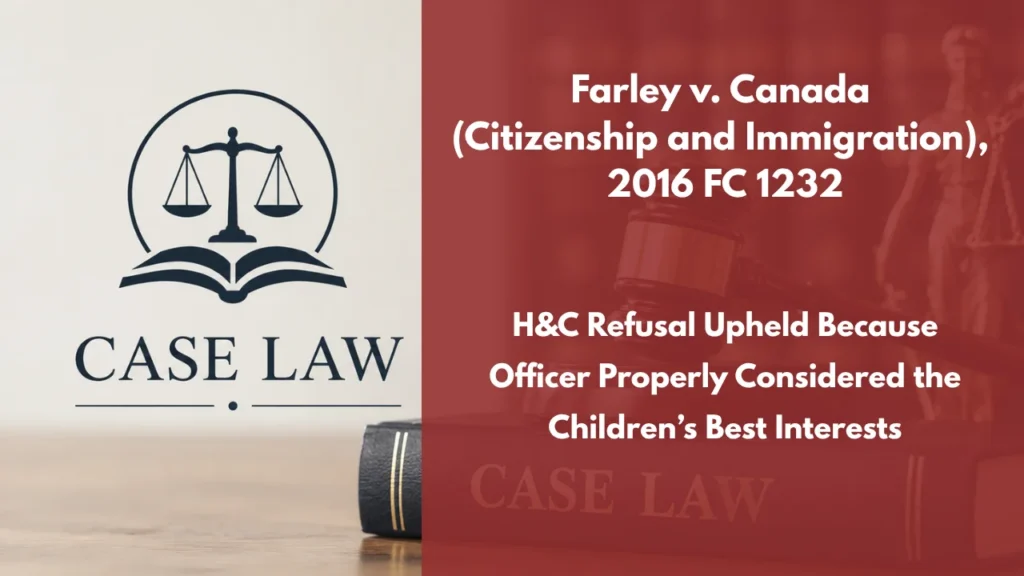
Farley v. Canada (Citizenship and Immigration), 2016 FC 1232 CanLII
Prepared by:
Dr. Muhammad
Abrar (Barrister and
Solicitor)
Author | Writer | Mentor | Legal Researcher | Canadian
Immigration Case Law and Statistics Analyst