Ø Introduction
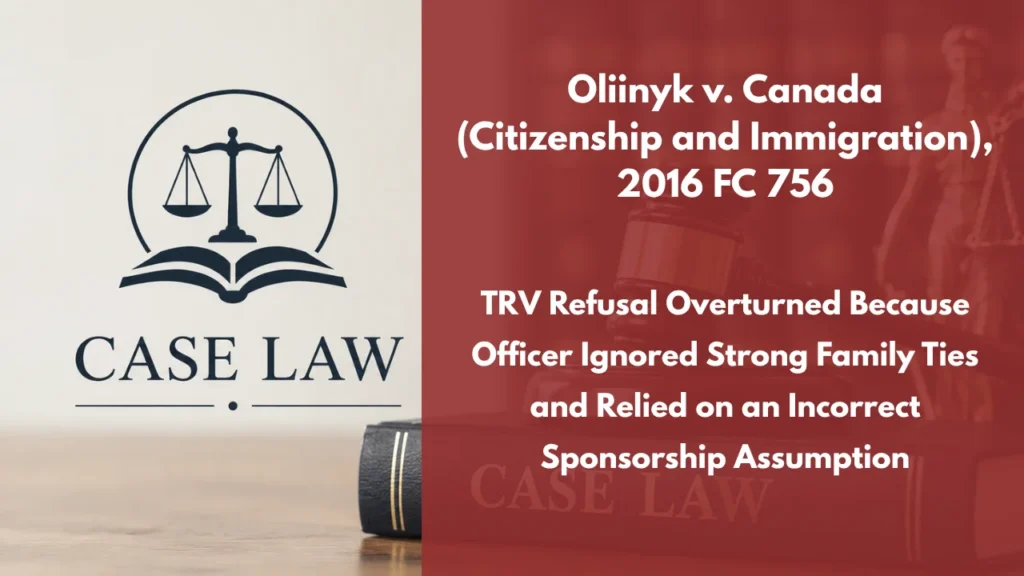
The Federal Court reviewed the refusal of a Temporary
Resident Visa application by a Ukrainian applicant who wished to visit her
Canadian permanent resident husband.
The Court overturned the refusal because the officer failed
to address important evidence showing that the applicant’s minor son and
parents remained in Ukraine and relied on the absence of a spousal sponsorship
application even though the applicant’s husband was legally unable to sponsor
her at that time.
Ø Key Principle
An officer does not have to mention every piece of evidence,
but the duty to address evidence increases when it is important and directly
contradicts the officer’s findings.
Where significant evidence supports an applicant’s ties to
their home country, the officer must meaningfully engage with that evidence
before concluding that the applicant has weak ties.
A decision-maker also cannot use an affidavit on judicial
review to add or improve the reasons given in the original decision.
Ø Background
The applicant was a Ukrainian citizen who was self-employed
as a tutor and lived with her young son and parents in Ukraine. She married a
Canadian permanent resident in April 2015 and applied for a TRV to visit him in
Canada for his birthday and the Christmas holidays.
The officer concluded that she had weak ties to Ukraine. The
officer relied partly on her self-employment, incomplete employment history,
her husband’s immigration history, and the fact that no spousal sponsorship
application had yet been submitted.
The applicant argued that the officer had ignored evidence
of her family and financial ties to Ukraine and had misunderstood why she had
not yet been sponsored.
Ø Court Findings
The Federal Court found the refusal unreasonable.
The Court emphasized that the officer did not mention
that the applicant’s minor son and parents remained in Ukraine. This
evidence directly contradicted the finding that she had weak ties to Ukraine.
The Court held that the absence of any analysis of this important evidence
allowed an inference that the officer had made the finding without regard to
the evidence.
The officer later attempted to explain through an affidavit
that the applicant’s son could simply be brought to Canada later. The Court
rejected this explanation, holding that an officer cannot supplement or
improve the reasons after the decision through an affidavit.
The Court also found it unreasonable to rely on the absence
of a spousal sponsorship application because the evidence showed that the
applicant’s husband was legally prohibited from sponsoring her until 2017.
These errors went to the heart of the officer’s conclusion
that the applicant lacked sufficient ties to Ukraine.
Ø Outcome
The Federal Court allowed the application for judicial
review and returned the TRV application to a different officer for
reconsideration.
Case Citation:
Oliinyk v. Canada (Citizenship and Immigration), 2016 FC 756 CanLII
Prepared by:
Dr. Muhammad
Abrar (Barrister and
Solicitor)
Author | Writer | Mentor | Legal Researcher | Canadian Immigration Case Law and
Statistics Analyst