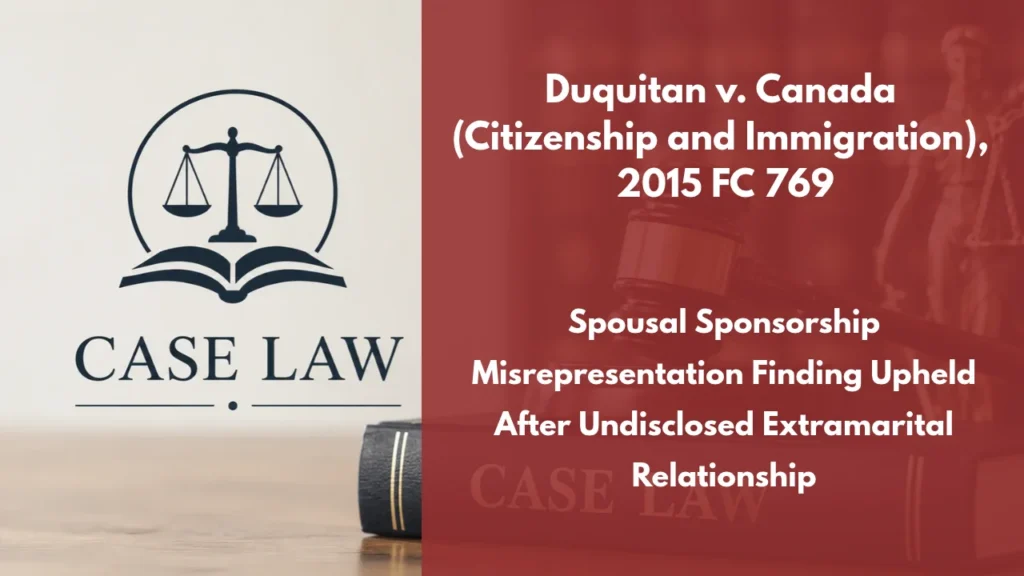
The Federal Court reviewed a finding that a permanent
resident was inadmissible for misrepresentation after failing to disclose an
ongoing intimate relationship with another woman during his spousal sponsorship
process.
The Immigration Appeal Division found that the undisclosed
relationship went directly to the genuineness of the marriage on which his
permanent residence was based.
The Federal Court upheld that decision.
Key Principle
Applicants have a broad duty to provide complete, honest,
and truthful information in immigration applications.
In a spousal sponsorship case, an undisclosed extramarital
relationship may be material because it can directly affect the assessment of
whether the sponsored marriage is genuine.
A misrepresentation does not have to guarantee a different
result. It is enough if the information could have affected the immigration
process or prompted further investigation.
Background
The applicant was a citizen of the Philippines who became a
permanent resident after being sponsored by his wife.
Soon after he became a permanent resident, his wife
discovered that he had maintained an intimate relationship with another woman.
She reported the matter to CBSA.
The applicant was later found inadmissible for
misrepresentation and an exclusion order was issued.
The IAD concluded that the undisclosed relationship was
material because it went to the core question of whether his marriage to the
sponsor was genuine.
Court Findings
The Federal Court found that the IAD’s conclusion was
reasonable.
The applicant’s failure to disclose the other relationship
prevented the visa officer from properly examining whether the marriage was
genuine.
The Court also upheld the IAD’s refusal to grant
humanitarian relief.
The IAD considered the seriousness of the misrepresentation,
the applicant’s lack of remorse, his establishment in Canada, potential
hardship in the Philippines, family circumstances, and the interests of
affected children.
Although the applicant had established himself in Canada,
the IAD found that the positive factors were not sufficient to overcome the
seriousness of the misrepresentation.
Outcome
The Federal Court dismissed the application for judicial
review.
The case shows that undisclosed relationships can have
serious immigration consequences where they are relevant to the genuineness of
a spousal sponsorship.
It also confirms that full disclosure is fundamental in
Canadian immigration applications.
Case Citation:
Duquitan v. Canada (Citizenship and Immigration), 2015 FC 769 CanLII
Prepared by:
Dr. Muhammad
Abrar (Barrister and
Solicitor)
Author | Writer | Mentor | Legal Researcher | Canadian
Immigration Case Law and Statistics Analyst