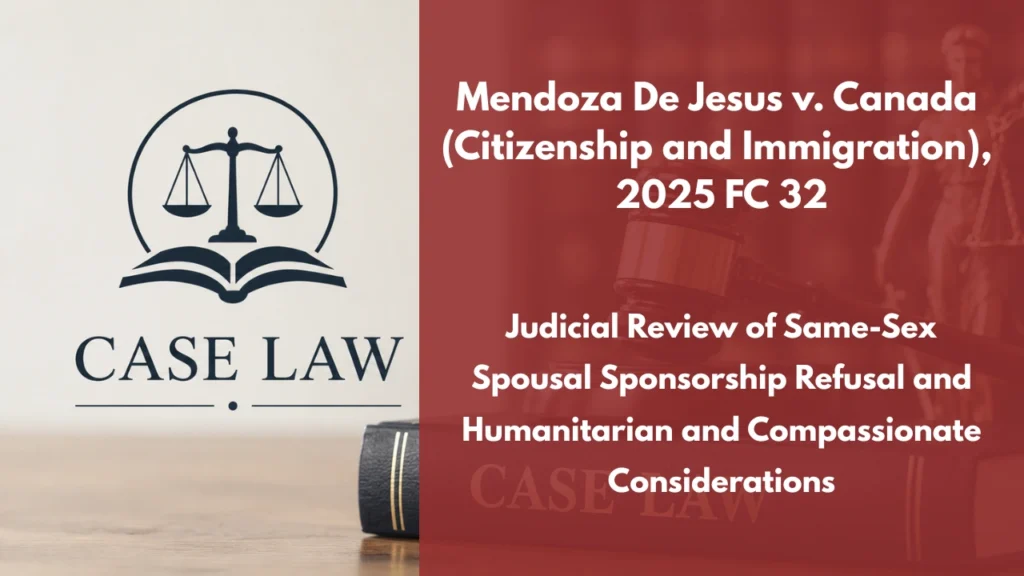
The Federal Court reviewed IRCC’s
refusal of Gracie Mendoza De Jesus’ conjugal partner permanent residence
application. The principal applicant was excluded from the family class under
paragraph 117(9)(d) of the Immigration and Refugee Protection Regulations
because her Canadian sponsor had not declared her as a common-law partner when
the sponsor previously obtained permanent residence. The officer also refused
humanitarian and compassionate relief. The Court upheld the fairness of the
process but granted judicial review because the H&C assessment failed to
meaningfully consider the applicants’ long-term same-sex relationship and the
legal, cultural, and psychological pressures that had required them to conceal
it.
Key Principle
An H&C assessment must be
holistic, empathetic, and responsive to the applicant’s unique circumstances.
An officer must not rely predominantly on the same non-disclosure that created
the statutory exclusion to also deny the relief intended to soften its harsh
consequences. In cases involving same-sex relationships maintained across
jurisdictions where such relationships are criminalized or socially condemned,
the officer must meaningfully consider how years of forced concealment may have
influenced the parties’ understanding, conduct, and reluctance to formally
declare the relationship.
Background
The applicants began a same-sex
relationship in the Philippines in 2004 and lived together from 2005. They
concealed the relationship because of religious, familial, and social
opposition.
They later moved to the United
Arab Emirates, where same-sex relationships were legally prohibited. The
sponsor eventually obtained Canadian permanent residence but did not declare
the principal applicant as her common-law partner. Consequently, the principal
applicant was not examined and became excluded from sponsorship under paragraph
117(9)(d).
The applicants later applied
under the conjugal partner class and submitted extensive evidence of their
relationship, including shared financial records, communications, photographs,
personal statements, and third-party support letters.
After a procedural fairness
letter, they requested several extensions while waiting for immigration
records. The officer granted multiple extensions but did not respond to the
final request submitted one day before the existing deadline.
Court Findings
• No Procedural Fairness
Breach Occurred
The applicants received
approximately 175 additional days beyond the original response period. The
final request was made only one day before the deadline, and procedural
fairness required a meaningful opportunity to respond, not an indefinite one.
• Extensive Relationship
Evidence Was Treated Superficially
The officer reduced decades of
financial interdependence, communication, cohabitation, personal statements,
and support letters to brief chronological observations without assessing their
substance.
• Same-Sex Relationship
Context Was Ignored
The officer did not consider how
legal prohibition and social hostility in the Philippines and UAE required
secrecy and may have shaped the sponsor’s failure to formally declare the
relationship.
• Non-Disclosure Was
Improperly Given Dispositive Weight
The officer relied heavily on the
sponsor’s failure to declare the relationship without contextualizing her
explanation that the relationship had never felt socially or legally validated.
This undermined the remedial purpose of H&C relief.
Outcome
The Federal Court granted
judicial review. The applicants were given 15 days to supplement their H&C
submissions, after which the matter was to be redetermined by a different
officer.
Case Citation:
Mendoza De Jesus v. Canada (Citizenship and Immigration), 2025 FC 32 (CanLII)
Prepared by:
Dr. Muhammad
Abrar (Barrister and
Solicitor)
Author | Writer | Mentor | Legal Researcher | Canadian Immigration Case Law and
Statistics Analyst