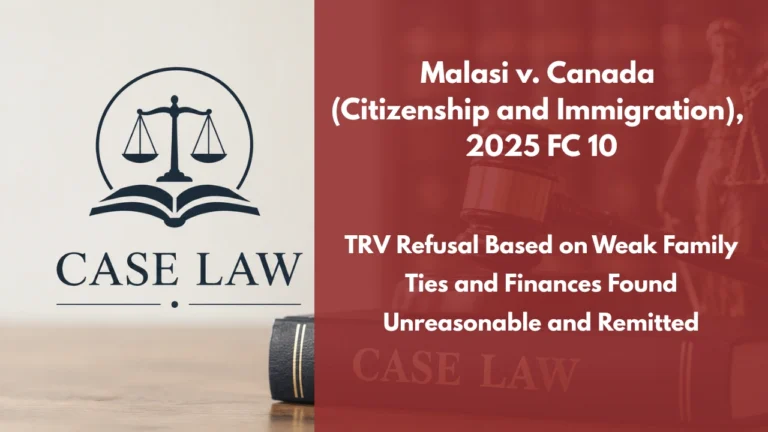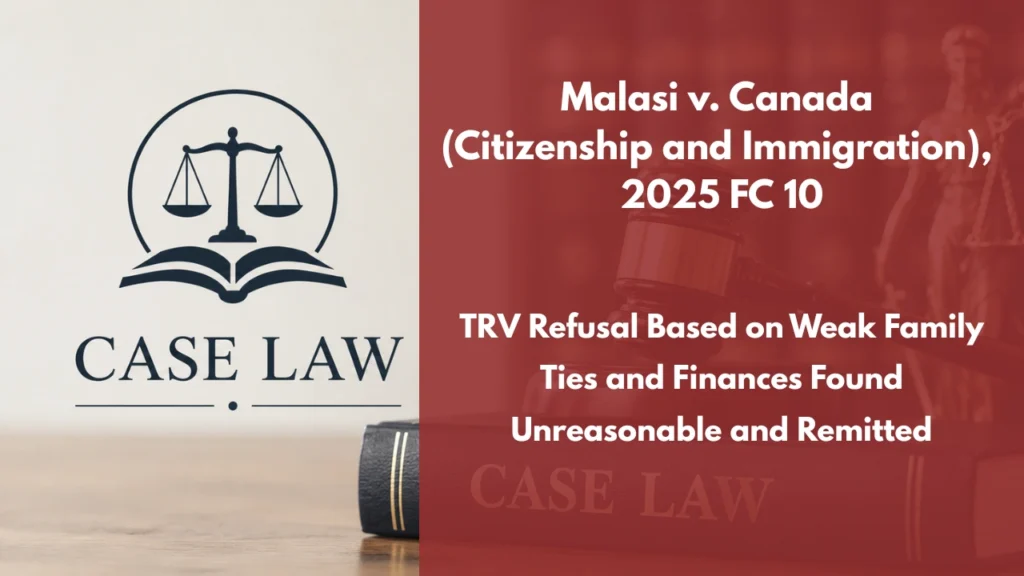
The Federal Court reviewed IRCC’s
refusal of Donaldo Malasi’s temporary resident visa application. The Albanian
applicant intended to visit his brother and family in Canada for one month. The
officer was not satisfied that he would leave Canada after his authorized stay,
citing insufficient financial documentation and weak emotional ties to Albania.
The Court upheld the officer’s concern regarding missing banking transaction
history but granted judicial review because the officer failed to address substantial
evidence of the applicant’s establishment and continuing obligations in
Albania.
Key Principle
A visa officer may reasonably
find that an applicant has not adequately demonstrated available funds where
the applicant fails to provide banking documents specifically required by the
applicable document checklist. However, where the refusal is based on multiple
factors, a financial concern does not automatically make errors concerning
other factors irrelevant. If ties to the home country are a central refusal
ground, the officer must meaningfully consider material evidence of residence,
property ownership, business operations, employment history, family
connections, travel compliance, and obligations requiring the applicant’s
return.
Background
The applicant sought a TRV to
spend one month with his brother and his brother’s family in Canada. He stated
that he would personally fund the trip.
The applicable visa office
checklist required three months of banking transaction history. The applicant
did not provide detailed bank statements or explain their absence. Although he
submitted financial information concerning his brother’s business, the
application did not state that the brother would finance the visit.
To demonstrate his ties to
Albania, the applicant stated that he had lived there his entire life, owned
the residence where he lived with his parents, and had owned and operated his
own business since 2018. Before starting the business, he had maintained stable
employment.
He also provided evidence that he
had travelled outside Albania on several occasions and had always returned. He
explained that he needed to return to continue operating his business.
The officer nevertheless
concluded that the applicant had no apparent ties to Albania and that his
emotional ties there were weak.
Court Findings
• Financial Concern Was
Reasonable
The officer could reasonably rely
on the applicant’s failure to submit the required banking transaction history.
The brother’s business records were not directly relevant because the applicant
stated that he would pay for the trip himself.
• Financial Concern Was Not
Necessarily Determinative
Unlike a study permit
application, where sufficient funds are an express statutory requirement, the
officer assessed the TRV application by weighing several factors. The reasons
did not state that the financial issue alone determined the outcome.
• Evidence of Establishment
Was Material
The applicant relied on home
ownership, residence with his parents, longstanding business ownership,
previous stable employment, positive travel history, and continuing business
responsibilities.
• Officer Failed to Engage
With Contrary Evidence
Although the officer did not need
to mention every document, the reasons did not address any of the evidence
supporting ties to Albania. This omission was significant because weak
home-country ties were a principal reason for refusal.
Outcome
The Federal Court granted
judicial review, set aside the TRV refusal, and returned the application to a
different officer for reconsideration. No question was certified.
Case Citation:
Malasi v. Canada (Citizenship and Immigration), 2025 FC 10 (CanLII)
Prepared by:
Dr. Muhammad
Abrar (Barrister and
Solicitor)
Author | Writer | Mentor | Legal Researcher | Canadian Immigration Case Law and
Statistics Analyst