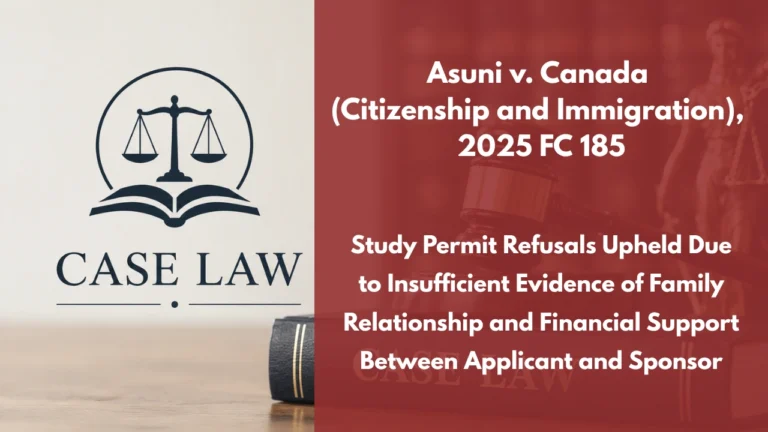
The Federal Court reviewed the
refusal of two study permit applications submitted by Oluwatoyosi Oreoluwa
Asuni, a Nigerian citizen seeking to study at Holland College. In both
applications, the applicant’s cousin was identified as her sole financial sponsor.
The officers were not satisfied that the claimed family relationship had been
adequately established and consequently were not persuaded that sufficient
financial resources were available or that the applicant would leave Canada
after her authorized stay. The Court dismissed judicial review, finding the
decisions reasonable and procedurally fair.
Key Principle
Where a study permit applicant
relies entirely on a third-party financial sponsor, the applicant must provide
convincing evidence establishing the nature and reliability of that
relationship. A bare statement that the sponsor is a cousin, supported only by
an unclear photograph or an unexplained family tree, may reasonably be found
insufficient. An officer is not required to request further evidence or warn
the applicant about deficiencies concerning statutory financial requirements.
Rejecting evidence as insufficient does not, without more, amount to an adverse
credibility finding requiring procedural fairness.
Background
The applicant submitted two study
permit applications to attend Holland College. In both applications, her cousin
agreed to act as her sole financial guarantor.
The sponsor’s evidence simply
stated that he was the applicant’s cousin. It did not explain whether they had
grown up together, belonged to a close-knit family, shared a household, or had
any previous history of financial support.
The first application included a
single dimly lit group photograph in which the applicant’s features were not
clearly visible. The same photograph was included with the second application,
along with a family tree.
Both officers found that there
was little evidence substantiating the relationship between the applicant and
the sponsor. As the sponsor was the sole source of financial support, the
officers were not satisfied that the applicant had demonstrated sufficient
available funds.
Court Findings
• Sponsor Relationship Was
Inadequately Documented
The sponsor provided no detailed
explanation of the family relationship or prior financial connection. The
evidence did not establish why he could reliably be expected to fund the
applicant’s studies.
• Photograph and Family Tree
Were Insufficient
The unclear group photograph did
little to prove the claimed relationship. The family tree in the second
application did not remedy the absence of detailed and reliable supporting
evidence.
• Financial Findings Were
Reasonable
Because the cousin was the sole
financial guarantor, doubts about the relationship directly affected whether
the applicant had established sufficient financial resources.
• No Procedural Fairness
Breach Occurred
The officers accepted the
documents as submitted but found that they did not prove the applicant’s claim.
This was an assessment of evidentiary sufficiency, not credibility. The
officers were not required to warn the applicant or provide an opportunity to
improve the applications.
Outcome
The Federal Court dismissed both
applications for judicial review and upheld the study permit refusals. No
question was certified.
Case Citation:
Asuni v. Canada (Citizenship and Immigration), 2025 FC 185 (CanLII)
Prepared by:
Dr. Muhammad
Abrar (Barrister and
Solicitor)
Author | Writer | Mentor | Legal Researcher | Canadian Immigration Case Law and
Statistics Analyst