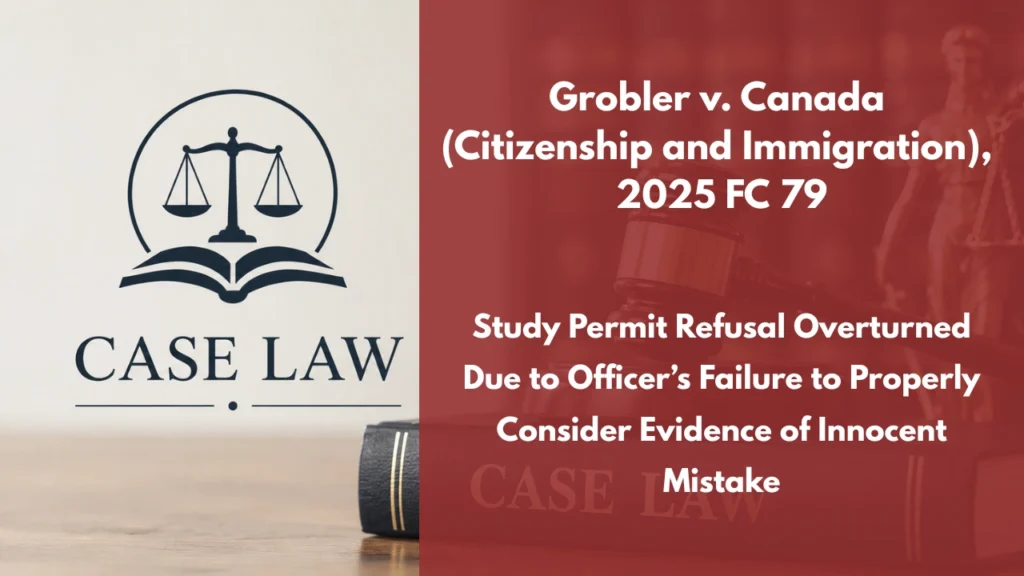
The Federal Court reviewed IRCC’s
refusal of Kelly Grobler’s study permit application and the accompanying
finding of inadmissibility for misrepresentation. The South African applicant
had failed to disclose an alleged 2014 conviction and a 2019 United States visa
refusal. In response to a procedural fairness letter, she explained that the
conviction had been expunged by the High Court of South Africa and that she had
understood the United States visa application to have been cancelled rather
than refused. The Court granted judicial review because the officer made
factual findings that contradicted the evidence and failed to adequately assess
the applicant’s innocent-mistake explanation.
Key Principle
A misrepresentation finding must
be justified in light of the applicant’s response to a procedural fairness
letter and the supporting evidence submitted. Where an applicant explains that
a conviction was judicially expunged or that a prior visa disposition was
misunderstood, the officer must accurately assess that evidence and provide a
sufficient rationale for rejecting an innocent-mistake explanation. A decision
is unreasonable where the officer makes findings of arrest, charge, or
continuing conviction that are contradicted by the record or appear to result
from overlooking or misunderstanding the evidence.
Background
The applicant was a South African
citizen who had held a Canadian multiple-entry visitor visa since 2019. In
March 2023, she applied for a study permit.
IRCC sent her a procedural
fairness letter alleging that she had failed to disclose a 2014 conviction and
a 2019 United States visa refusal.
The applicant responded that the
South African High Court had expunged the conviction, meaning that no
conviction continued to exist. She submitted the supporting material available
to her.
Regarding the United States visa,
she explained that she believed the application had been cancelled because she
was unable to provide requested information during the early COVID-19 period.
She stated that she did not know it had been recorded as a refusal until
receiving IRCC’s procedural fairness letter.
The Immigration Program Manager
nevertheless found that she had misrepresented material information and
declared her inadmissible.
Court Findings
• Findings Contradicted the
Record
The officer concluded that the
applicant had been charged and arrested in South Africa and that the conviction
had not been expunged. These findings were inconsistent with the evidence
submitted in response to the procedural fairness letter.
• Evidence Was Overlooked or
Misunderstood
The Court found that the officer
either failed to consider the applicant’s evidence or misunderstood its legal
and factual significance.
• Innocent-Mistake Explanation
Was Not Properly Assessed
The applicant provided
explanations for both incorrect answers. The officer did not give sufficient
reasons for rejecting her claim that the omissions resulted from genuine
misunderstanding.
• Study Permit Refusal Could
Not Stand
Because the inadmissibility
finding was unreasonable, the resulting refusal of the study permit application
was also unreasonable.
Outcome
The Federal Court granted
judicial review, set aside the misrepresentation finding and study permit
refusal, and returned the application to a different officer for
redetermination. No question was certified.
Case Citation:
Grobler v. Canada (Citizenship and Immigration), 2025 FC 79 (CanLII)
Prepared by:
Dr. Muhammad
Abrar (Barrister and
Solicitor)
Author | Writer | Mentor | Legal Researcher | Canadian Immigration Case Law and
Statistics Analyst