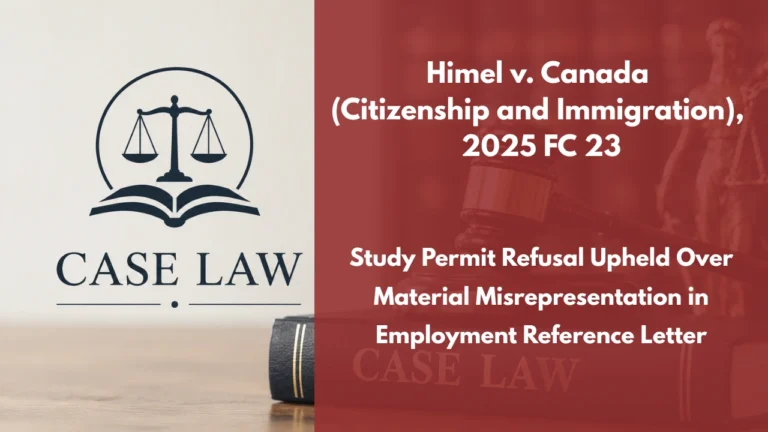
The Federal Court reviewed IRCC’s
refusal of Mr. Himel’s LMIA-based work permit application and the accompanying
five-year misrepresentation finding. The applicant had submitted an employment
reference letter purportedly signed by his current employer in Singapore. After
IRCC contacted the employer, the employer denied issuing or signing the letter.
Although the applicant later submitted extensive evidence confirming that he
had genuinely performed the stated work, the Court upheld the decision because the
initial reference letter itself was not authentic and was material to the work
permit assessment.
Key Principle
A misrepresentation may arise
even where the underlying employment information is substantially accurate if
the applicant submits a document falsely presented as having been issued or
signed by an employer. Authenticity and truthfulness are distinct requirements.
A fraudulent employment reference letter is material where it could influence
an officer’s assessment of whether the applicant has the qualifications and
experience necessary to perform the proposed Canadian employment. Subsequent
evidence confirming the underlying work experience does not necessarily
eliminate the original misrepresentation.
Background
The applicant, a Bangladeshi
citizen working in Singapore, applied for a Canadian work permit supported by a
positive Labour Market Impact Assessment for employment as a metal fabricator.
He submitted a reference letter
dated August 2022 that purported to be issued and signed by the managing
director of his current employer. The letter described approximately five years
of employment, duties, and salary.
After noticing similarities
between reference letters from different employers, the officer contacted the
applicant’s employer. The employer stated that the company had not issued the
letter and that the signature was not genuine.
IRCC sent the applicant a
procedural fairness letter. He admitted that he had not requested the original
letter from his employer because he feared losing his employment and
immigration status in Singapore if the employer learned he was seeking work
elsewhere.
He then submitted a genuine
employer letter, government employment records, work authorization documents, a
supervisor’s statutory declaration, tax records, payslips, and bank statements
confirming his employment.
Court Findings
• Submission of the False
Letter Was a Misrepresentation
The applicant admitted that he
had not obtained the original letter from the employer, despite submitting it
as an employer-issued and signed document. The officer reasonably found that
this constituted misrepresentation.
• Accuracy of Employment
Details Did Not Cure the False Document
The later documents may have
confirmed that the applicant worked as a metal fabricator, but they did not
change the fact that the initial reference letter was fraudulent.
• Misrepresentation Was
Material
The letter was relevant to
determining whether the applicant had the experience and qualifications
necessary to perform the proposed work. It therefore could have induced an
error in administering the legislation.
• Procedural Fairness Was
Satisfied
The procedural fairness letter
clearly identified the concern. The officer considered the applicant’s response
and supporting documents but remained unconvinced regarding the fraudulent
letter. The applicant knew the case he had to meet and had a meaningful
opportunity to respond.
Outcome
The Federal Court dismissed the
application for judicial review and upheld the work permit refusal and
five-year inadmissibility finding. No question was certified.
Case Citation:
Himel v. Canada (Citizenship and Immigration), 2025 FC 23 (CanLII)
Prepared by:
Dr. Muhammad
Abrar (Barrister and
Solicitor)
Author | Writer | Mentor | Legal Researcher | Canadian Immigration Case Law and
Statistics Analyst