Introduction
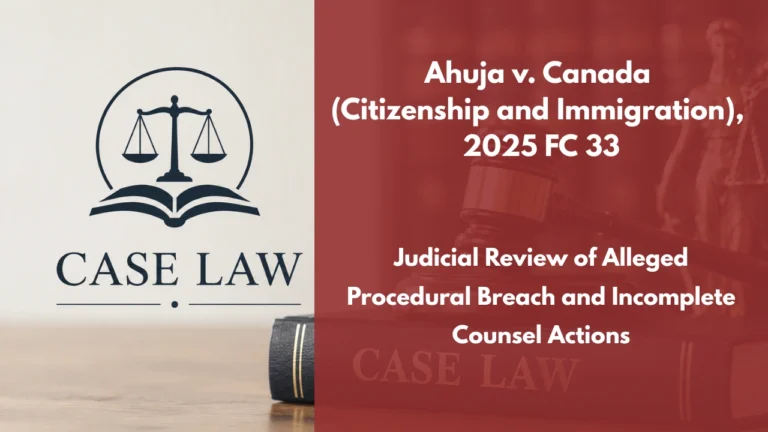
The Federal Court reviewed the
rejection of Harpreet Kaur Ahuja’s Canadian Experience Class permanent
residence application as incomplete. The application included an expired
medical examination for her non-accompanying spouse instead of a valid upfront examination.
The applicant argued that her former counsel’s incompetence caused the
rejection and amounted to a breach of natural justice. The Court dismissed
judicial review because the cumulative test for ineffective assistance was not
established and current counsel did not fully comply with the Federal Court’s
protocol governing allegations against former representatives.
Key Principle
An allegation that former
immigration counsel was incompetent requires proof that counsel’s conduct
constituted incompetence or negligence, that a miscarriage of justice resulted
because there was a reasonable probability of a different outcome, and that
former counsel received a fair opportunity to respond. All three requirements
must be met. Counsel’s conduct is presumed to fall within a broad range of
reasonable professional assistance, and incompetence sufficient to breach
natural justice will arise only in extraordinary circumstances. Current counsel
must also strictly observe the Federal Court’s protocol by providing the former
representative with the allegations, supporting evidence, the prescribed
response period, the perfected record, and the order granting leave.
Background
The applicant received an
invitation to apply for permanent residence through Express Entry. Her
non-accompanying spouse’s previous medical examination had expired, but counsel
submitted it with a request that IRCC advise if a new examination was necessary.
IRCC rejected the application as
incomplete because a valid upfront medical examination for the non-accompanying
spouse was required when the application was filed. A reconsideration request
was also refused.
The applicant alleged that former
counsel failed to advise her properly and submitted an incomplete application
despite having time to obtain a new examination. Former counsel responded that
the applicant knew an upfront examination was required, wanted the application
filed urgently, and agreed to submit the expired examination with an
explanation while arranging a new one.
Current counsel did not provide
former counsel with all supporting evidence, gave seven rather than ten days to
respond, and did not establish that the order granting leave was provided.
Court Findings
• Protocol Compliance Was
Incomplete
The protocol exists to ensure
fairness to former representatives facing potentially serious professional
allegations. The failure to provide supporting evidence and the leave order
undermined the fairness of the process.
• Different Result Was
Reasonably Probable
The Court accepted that the
application likely would not have been rejected as incomplete if a valid
medical examination had been included.
• Incompetence Was Not
Established
Submitting the expired
examination with an explanation, while anticipating that an updated examination
could follow, was not shown to fall clearly outside the range of reasonable
professional judgment.
• Evidence Showed Awareness of
the Requirement
Email correspondence indicated
that the applicant and her employer knew that an upfront medical examination
for the spouse was required.
• New Allegations Could Not Be
Raised Without Notice
Claims made at the hearing that
former counsel had lied about filing dates and webform submissions had not been
put to former counsel and therefore could not be considered.
Outcome
The Federal Court dismissed the
application for judicial review, finding that the applicant had not proven the
required elements of counsel incompetence. No question was certified.
Case Citation:
Ahuja v. Canada (Citizenship and Immigration), 2025 FC 33 (CanLII)
Prepared by:
Dr. Muhammad
Abrar (Barrister and
Solicitor)
Author | Writer | Mentor | Legal Researcher | Canadian Immigration Case Law and
Statistics Analyst