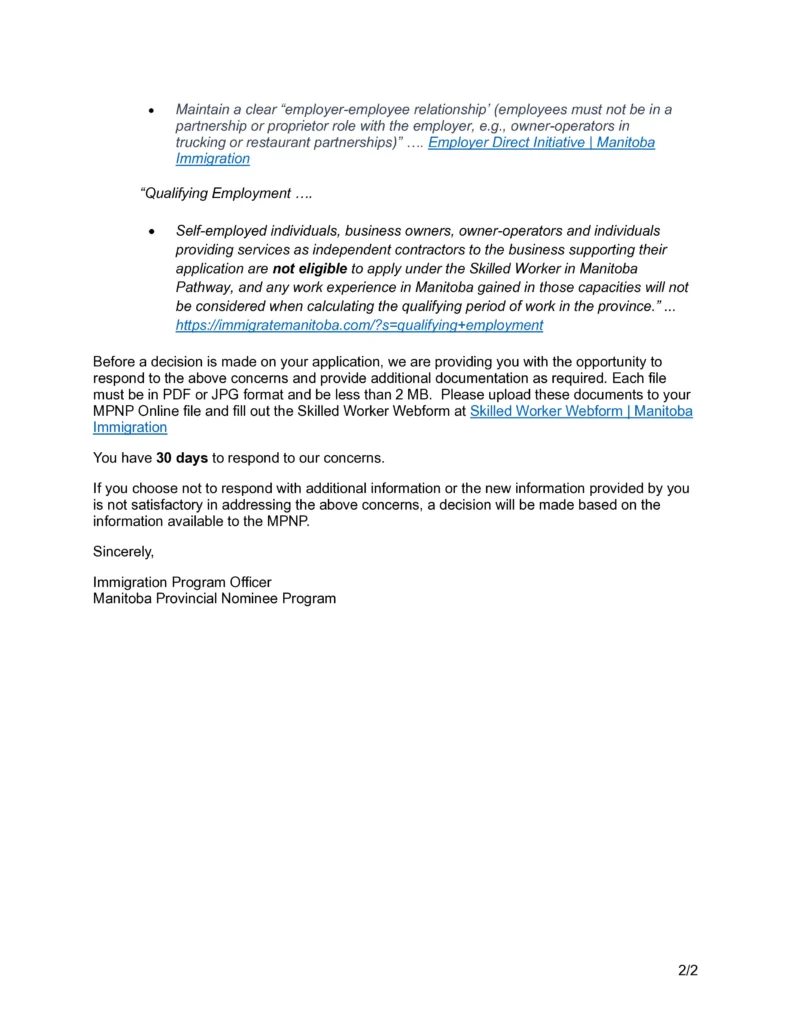
MPNP Procedural Fairness Letter (PFL): How to Calculate Work Experience (Rules, Examples, and Responses)
One of the main reasons for an MPNP Procedural Fairness Letter (PFL) or refusal is incorrectly calculating work experience in the Expression of Interest (EOI). An applicant may receive a PFL if the MPNP believes the work experience was not calculated properly, whether through miscounted months, overlapping employment periods, or periods that don’t qualify. When this happens, the applicant may have claimed more points than they are entitled to.
This article is organized into two parts. Part One sets out the method for correctly calculating years of work experience for the purposes of a Manitoba Provincial Nominee Program (MPNP) Expression of Interest (EOI). Part Two addresses the available remedies and recommended steps where an applicant receives a Procedural Fairness Letter (PFL) challenging the work experience claimed.
Part One: How to Calculate Work Experience for the MPNP EOI
According to the MPNP’s official EOI guidelines, an applicant must calculate the total number of full years of work experience completed over the five years immediately preceding the date on which the EOI is submitted. Only experience gained within this five-year window may be counted. Experience falling outside of it, however relevant, does not contribute to the total. Qualifying experience may be counted whether it was gained in Canada or abroad, provided it falls within the five-year window.
In calculating this total, the MPNP’s official EOI guidelines permit an applicant to count only periods of full-time employment with an employer that lasted six months or more. Full-time employment is defined as at least 30 hours of work per week. Periods of part-time work, or employment lasting fewer than six months, do not qualify and should not be included in the calculation.
Once all qualifying employment periods have been added together, the total must not be rounded up. Only completed years are counted. For example, an applicant who has accumulated three years and ten months of qualifying work experience must declare three years, not four. Rounding up is a common source of error and may result in an applicant claiming more points than they are entitled to, which can in turn lead to a Procedural Fairness Letter (PFL) or a refusal.
| MPNP EOI Work Experience: Year Calculation | |||||
|---|---|---|---|---|---|
| Scenario | 1st Job | 2nd Job | 3rd Job | Total Period/Years | Years in EOI |
| 1 | 11 Months | 11 Months | 0 years | ||
| 2 | 5 Months* | 6 Months | 11 Months | 0 years | |
| 3 | 6 Months | 7 Months | 1 Years & 1 Months | 1 year | |
| 4 | 2 years | 3 Months* | 6 Months | 2 Years & 9 Months | 2 years |
| 5 | 2 years & 3 Months | 7 Months | 1 Year | 3 Years & 10 Months | 3 years |
| 6 | 4 Months* | 4 Years | 7 Months | 4 Years & 11 Months | 4 years |
| ✱ Do not count work experience of less than 6 months. | |||||
The table above illustrates six different scenarios to help applicants understand how to correctly calculate their eligible work experience, gained through different jobs over the last five years, when completing an MPNP Expression of Interest (EOI).
The Six Scenarios Explained
Scenario 1: Less Than One Year of Work Experience in One Job
An applicant has worked for one employer for 11 months. Although the employment meets the minimum six-month requirement, the applicant has not completed a full year. Therefore, the applicant must declare 0 years in the EOI.
Scenario 2: Work Experience in Two Jobs, One Ineligible
An applicant has worked for five months with the first employer and six months with the second employer. Since the first job does not meet the minimum six-month requirement, only six months of work experience qualify. Therefore, the applicant must declare 0 years in the EOI.
Scenario 3: Combining Work Experience from Two Jobs
An applicant has worked for six months with the first employer and seven months with the second employer. Both employment periods meet the minimum six-month requirement, resulting in one year and one month of eligible work experience. The applicant can claim 1 year in the EOI.
Scenario 4: Excluding Ineligible Work Experience
An applicant has worked in three different jobs for two years, three months and six months, respectively. The three-month employment period must be excluded from the calculation. The remaining eligible work experience is two years and six months. Therefore, the applicant can claim 2 years in the EOI.
Scenario 5: Combining Eligible Work Experience from Three Jobs
An applicant has worked in three different jobs for two years and three months, seven months and one year, respectively. All three employment periods qualify, resulting in three years and ten months of eligible work experience. Since incomplete years cannot be rounded up, the applicant must declare 3 years in the EOI.
Scenario 6: Work Experience Just Short of Five Years
An applicant has worked in three different jobs for four months, four years and seven months, respectively. After excluding the four-month employment period, the applicant has four years and eleven months of eligible work experience. Despite being only one month short of five years, the applicant must declare 4 years in the EOI.
These scenarios illustrate three rules applicants must follow:
- Employment periods of less than six months must be excluded.
- All eligible work experience from different jobs must then be combined.
- Finally, only the completed full years of that combined total are counted, without rounding up.
An incorrect calculation can inflate the EOI score, which may lead to a Procedural Fairness Letter (PFL) or a refusal.
Update Your EOI When You Complete Another Year
Unlike Express Entry, the MPNP does not update your work experience points automatically. In an MPNP EOI, you have to update your work experience manually, so your profile keeps showing the experience you first declared until you change it. When you complete another full year of qualifying work, you should update and resubmit your EOI. The MPNP allows this if you gain an additional full year before receiving a Letter of Advice to Apply, and your score will be adjusted. Updating on time matters because more points give you a better chance of being invited in a draw. If your EOI was submitted through a representative’s portal, let your representative know as soon as you complete another full year, so they can update your profile accordingly.
Part-Time Employment Exceeding 30 Hours per Week
If you regularly work more than 30 hours a week, 60 hours bi-weekly, or 65 hours semi-monthly, or 130 hours per monthly pay period, then your employment meets MPNP eligibility of full time.
Paid sick leave, parental, vacation leave and WCB are counted as part of employment eligibility.
Every rule has exceptions, and understanding them can make the difference between a refusal and an approval. In some cases, a job described as part-time may involve more than required hours. The MPNP may consider such employment as full-time experience, but this is not guaranteed. Whether it is accepted rests entirely with the assessing officer’s discretion and depends on the nature of the job and the circumstances of each case. Applicants should not assume that this experience will be counted, and should keep supporting documents, such as employment letters, pay stubs, and records of weekly hours, to show that the hours worked met the full-time requirement.
Part Two: Responding to a Work Experience PFL
If a Procedural Fairness Letter (PFL) states that your work experience was calculated incorrectly, you may respectfully submit that the error did not change the outcome of your Expression of Interest. You should begin by recalculating your work experience and your total EOI score correctly. If the corrected score is still equal to or higher than the lowest score invited in your draw, you would have been invited in any event and gained no advantage from the error. The same reasoning may apply to an occupation-specific draw with no minimum score, where the invitation was issued because you met the draw’s criteria and not because of your points.
You should also explain that the error was an honest miscalculation and not an attempt to mislead the MPNP, and support your explanation with a clear month-by-month calculation and strong documentary evidence.
Useful documents include:
- Employment letters stating your job title, duties, start and end dates, and weekly hours
- Pay stubs and payroll records
- Bank statements showing regular salary deposits
- T4 slips, Notices of Assessment, or equivalent tax records
- Employment contracts
- Records of Employment (ROE)
- Timesheets or work schedules
- Reference letters from employers or supervisors
Together, these documents show the true dates and hours of your employment from several independent sources.
These points are reasons for the officer to consider exercising discretion in your favour, but they do not guarantee a positive result. The MPNP may still refuse the application if the documents do not support the experience claimed, or if it considers the error to be misrepresentation. For this reason, it is advisable to respond to the PFL within the stated deadline, to be accurate and consistent in everything you submit, and to seek advice from a licensed immigration professional before sending your response.
How A&M Can Help
At A&M Canadian Immigration Law Corporation, Dr. Muhammad Abrar, PhD in Law, assists applicants with complex Canadian immigration matters, including MPNP Procedural Fairness Letters.
Our Canadian Immigration Case Law Library provides access to Federal Court decisions organized by immigration topic, helping applicants and legal professionals identify relevant legal principles when preparing their responses.
If you have received a Manitoba Provincial Nominee Program (MPNP) Procedural Fairness Letter (PFL) concerning the calculation of your work experience, the response you submit can decide the outcome of your application. A&M Canadian Immigration Law Corporation, a Winnipeg-based immigration-only law firm, represents applicants in MPNP PFL responses, including work experience calculation errors, overlapping employment periods, and misrepresentation concerns. Dr. Muhammad Abrar, Barrister and Solicitor, prepares each response with a corrected calculation, supporting evidence, and legal submissions. Book your first free in-person consultation with an experienced MPNP PFL lawyer in Winnipeg today.
Frequently Asked Questions
Can I round up my work experience in the MPNP EOI?
No. The MPNP counts only completed years of eligible work experience. For example, 2 years and 11 months must be declared as 2 years, not 3 years. Rounding up is a common source of error and may lead to a Procedural Fairness Letter (PFL) or a refusal.
How do I calculate broken months of work experience for the MPNP with 2 employers?
First, exclude any job that lasted less than six months. Then add together the eligible periods from both employers and count only the completed full years of the total, without rounding up. For example, if you worked 1 year and 10 months for one employer and 7 months for another, both periods qualify and the total is 2 years and 5 months. You would declare 2 years in your EOI. If the second job lasted only 5 months, it would be excluded and you would declare 1 year.
How far back can I count work experience in my EOI?
You may count only the work experience completed during the five years immediately before the date you submit your EOI. Experience outside this window does not contribute to the total.
Can I count work experience gained outside Canada?
Yes. Work experience gained either in Canada or abroad may be counted, provided it falls within the five-year window and meets the other requirements.
Do jobs lasting less than six months count?
No, they don’t. Any job that lasted less than six months is left out of your calculation. Say you had three jobs: your first job lasted 4 months, your second job lasted 4 years and 1 month, and your third job lasted 6 months. You would drop the first job and add up the other two, which gives you 4 years and 7 months. Since you can only count full years, you would declare 4 years in your EOI.
Can I combine work experience from different employers?
Yes. You can combine work experience from different employers. First, leave out any job that lasted less than six months. Then add together the remaining jobs and count only the completed full years of the total. For example, 2 years and 3 months with one employer plus 7 months with another gives 2 years and 10 months, so you would declare 2 years.
What if my job was part-time but I worked more than 30 hours a week?
Your employment meets the MPNP full-time requirement if you regularly work more than 30 hours a week, 60 hours bi-weekly, 65 hours semi-monthly, or 130 hours per monthly pay period. Paid sick leave, parental leave, vacation leave and WCB are counted as part of employment eligibility. Even if your job is described as part-time, the MPNP may consider it full-time experience if you regularly worked these hours, but this is not guaranteed. The decision rests with the assessing officer’s discretion and depends on the nature of the job and the circumstances of your case. Keep employment letters, pay stubs, and records of weekly hours to support your claim.
Does my work experience update automatically in the MPNP EOI?
No. Unlike Express Entry, the MPNP does not update your work experience points automatically. When you complete another full year of qualifying work, you should update and resubmit your EOI. If a representative submitted your EOI through their portal, let them know as soon as you complete another full year.