The Federal Court reviewed the
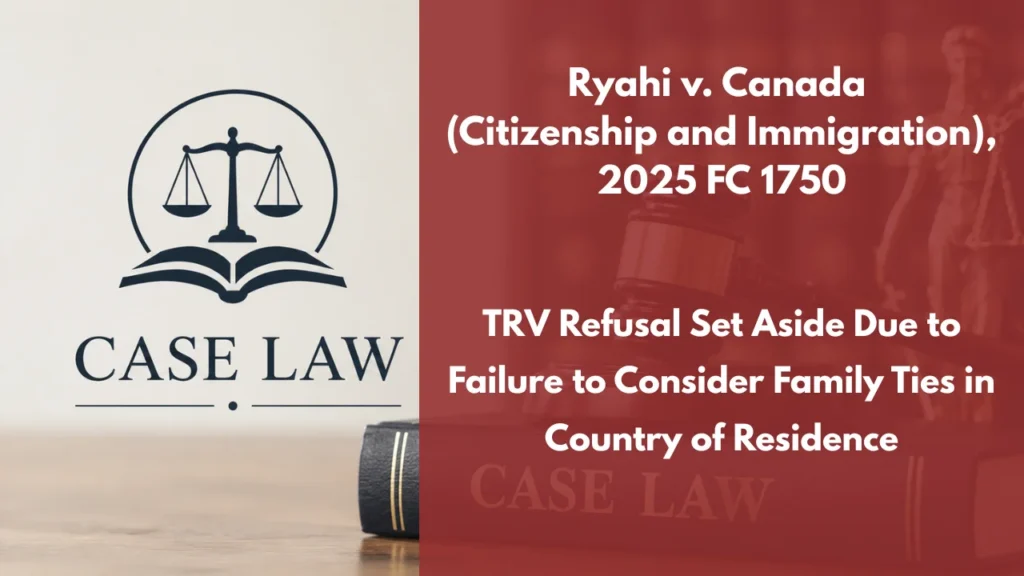
refusal of temporary resident visa (TRV) applications for Naghmeh Ryahi and her
adult son, Reza Mokarizadeh. The TRVs were intended for a short visit to Canada
to see Ms. Ryahi’s spouse and Reza’s stepfather, who hold work permits. The
refusal was based solely on the applicants’ family ties in Canada, with no
assessment of their family connections in Iran. The Court found the decision
unreasonable and remitted the matter for reconsideration.
Key Principle
When assessing whether a foreign
national will leave Canada at the end of an authorized stay, visa officers must
consider both the “push” factors anchoring the applicant to their home country
and the “pull” factors drawing them to Canada. Ignoring evidence of ties in the
country of residence undermines the intelligibility and justification of a
decision. Officers are presumed to have considered all evidence, but their
reasons must demonstrate that the analysis was carried out in a balanced manner.
Background
Ms. Ryahi, an Iranian citizen and
hair transplant technician, applied for a TRV along with her son in June 2024
for a one-month visit from August 30 to September 28, 2024. Her Family
Information Form identified her mother and brother in Iran, demonstrating
substantial family ties. The officer refused the applications on July 29, 2024,
stating the applicants had significant family ties in Canada and that the
purpose of the visit was inconsistent with a temporary stay.
The Global Case Management System
(GCMS) notes mirrored these reasons but did not reference the applicants’
family in Iran.
Court Findings
• Failure to Assess Ties in
Iran
The Court held that the officer
unreasonably failed to consider countervailing ties in Iran. Simply noting
Canadian family ties without weighing them against those in the country of
residence constitutes a reviewable error.
• Push/Pull Analysis Required
The Court emphasized that
assessing temporary resident applications requires a clear analysis of push and
pull factors. Where the officer fails to demonstrate consideration of the
applicant’s connections to their home country, the reasoning is neither intelligible
nor justified.
• Deference Limited by Absence
of Justification
While deference is owed to visa
officers, the absence of a rational explanation for dismissing evidence on
family ties in Iran prevents the decision from meeting the standard of
reasonableness established in Vavilov and related jurisprudence .
Outcome
The Federal Court granted the
judicial review and ordered that the TRV applications be reconsidered by a
different officer. No question of general importance was certified.
Case Citation:
Ryahi v. Canada (Citizenship and Immigration),
2025 FC 1750 (CanLII)
Prepared by:
Dr. Muhammad Abrar (Barrister and Solicitor)
Author | Writer | Mentor | Legal Researcher | Canadian Immigration Case Law and Statistics Analyst