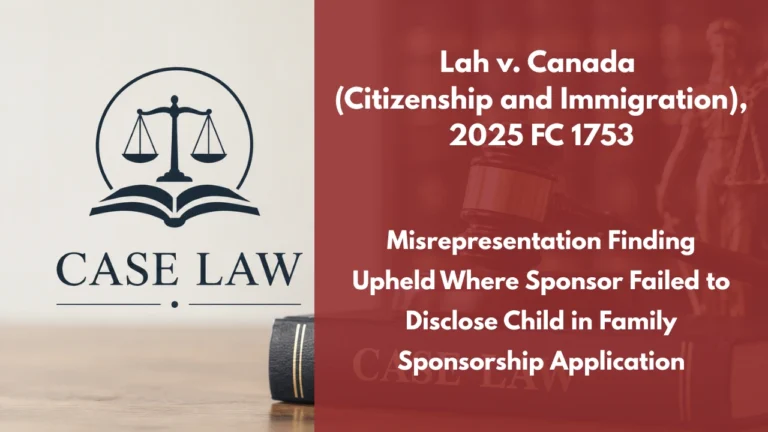
The Federal Court reviewed IRCC’s
refusal of Sovanna Lah’s permanent residence application under the family
sponsorship program. The application was refused after IRCC found that her
brother, Rokrofi Lah, had misrepresented his family circumstances by stating
that he had no children when he had a daughter in Cambodia. The Court dismissed
the judicial review, finding that the officer reasonably concluded the omission
was material and did not qualify as an innocent mistake.
Key Principle
The Federal Court reaffirmed that
misrepresentation under section 40 of the Immigration and Refugee Protection
Act (IRPA) does not require an intention to deceive. An omission or
inaccurate statement may result in inadmissibility if it could affect the
administration of the Act. Applicants and sponsors have a duty to provide
complete and truthful information, even where they misunderstand immigration
rules or rely on advice from others.
Background
Rokrofi Lah became a Canadian
citizen in 2023 after obtaining permanent residence through spousal
sponsorship. He later applied to sponsor his sister, Sovanna Lah, under the
“lonely Canadian” sponsorship category, which allows sponsorship of certain
relatives when the sponsor has no other eligible family members.
Mr. Lah had a daughter from a
previous relationship in Cambodia. During his own permanent residence
application, he had declared his daughter, but she was not able to immigrate
because her mother did not permit the required medical examination.
When sponsoring his sister, Mr.
Lah stated on multiple forms that he had no children. IRCC later discovered the
existence of his daughter and issued a procedural fairness letter, raising
concerns that the omission was a misrepresentation because the daughter’s
existence could affect eligibility under the sponsorship category.
Mr. Lah responded that he
believed his daughter was no longer considered his child for immigration
purposes because of the custody arrangement and previous advice from his
representative.
Court Findings
• Misrepresentation Was
Material
The Court held that the officer
reasonably found the omission material. Even if Mr. Lah could not directly
sponsor his daughter because she had not been examined during his own
immigration process, IRCC needed the opportunity to assess whether other options
or public policies applied.
The Court emphasized that it was
not for the applicant to decide whether the daughter’s existence was relevant.
By stating that he had no children, Mr. Lah prevented IRCC from conducting the
required assessment.
• Innocent Mistake Argument
Rejected
The Court found that the officer
properly considered whether the omission was an innocent mistake. However, the
officer reasonably concluded that multiple explicit statements denying the
existence of children, combined with the fact that disclosure could affect
eligibility, made intentional omission more likely than misunderstanding.
• Court Did Not Reweigh
Evidence
Justice Grant acknowledged that
Mr. Lah may have genuinely misunderstood his reporting obligations but held
that this possibility did not make the officer’s decision unreasonable.
Judicial review does not permit the Court to substitute its own assessment of
the evidence.
Outcome
The Federal Court dismissed the
application for judicial review. The Court found that the misrepresentation
finding was reasonable and that the five-year inadmissibility consequence under
IRPA remained valid. No question was certified.
Case Citation:
Lah v. Canada (Citizenship and Immigration), 2025 FC 1753 (CanLII)
Prepared by:
Dr. Muhammad Abrar (Barrister and Solicitor)
Author | Writer | Mentor | Legal Researcher | Canadian Immigration Case Law and Statistics Analyst