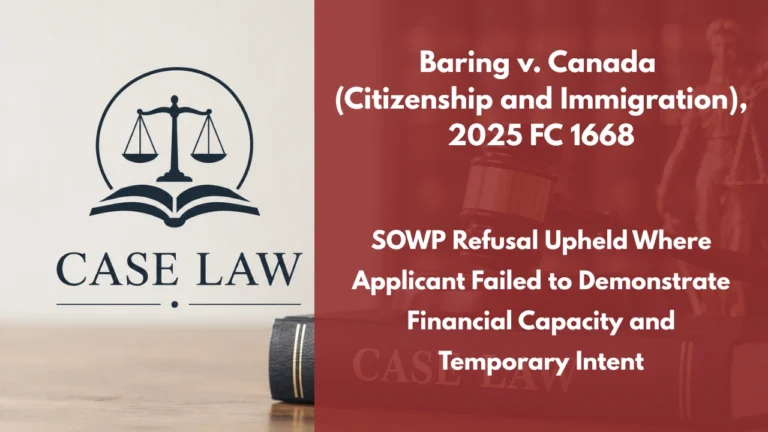
The Federal Court reviewed IRCC’s
refusal of Arshdeep Singh Baring’s spousal open work permit application under
the International Mobility Program. The application was refused under paragraph
200(1)(b) of the Immigration and Refugee Protection Regulations (IRPR)
due to insufficient financial evidence demonstrating that the applicant and his
spouse could support themselves and that the applicant would leave Canada at
the end of his stay. The Court dismissed the judicial review, finding the
officer’s decision reasonable and supported by the record .
Key Principle
Visa officers have broad
discretion to assess financial sufficiency and ties to the home country.
Reasonableness review is deferential: the Court examines whether the decision
exhibits justification, transparency, and intelligibility, and whether it is supported
by a rational chain of analysis. Minor missteps or perceived gaps do not render
a decision unreasonable if the overall assessment is coherent .
Background
The applicant, an Indian citizen,
was employed as a bookkeeper. His spouse, residing in Canada, was employed as
an administrative assistant. The applicant submitted limited financial
documentation: a letter of employment, a single-page bank statement, an income
tax acknowledgment, a multi-page assets report commingling his assets with
those of his parents, an affidavit from his parents promising financial
support, and pay stubs and bank statements for his spouse .
The officer considered all
submissions, noting deficiencies such as lack of transaction history, limited
provenance of funds, no evidence of joint accounts, and uncertainty about
availability of funds to support both the applicant and his spouse .
Court Findings
• Reasonableness of Financial
Assessment
The Court found that the
officer’s assessment was reasonable. While the applicant argued the officer
misapprehended the financial evidence, the Court noted that there were no
fundamental errors in fact-finding. The officer appropriately weighed the sufficiency
and availability of funds in determining whether the applicant could support
himself and his spouse and leave Canada at the end of the stay .
• Procedural Fairness
The applicant argued he should
have been given an opportunity to address perceived deficiencies. The Court
rejected this, observing that procedural fairness is triggered primarily when
credibility or genuineness of evidence is questioned. Here, the officer’s
concerns related to the adequacy and sufficiency of financial documentation,
not credibility, and procedural fairness was satisfied .
• Discretion of Visa Officers
The Court emphasized that
officers are entitled to consider multiple factors—including employment,
savings, family ties, and intent to return—when assessing eligibility for a
work permit. Deference is owed to these determinations absent evidence of fundamental
error .
Outcome
The judicial review was
dismissed. The refusal of the spousal open work permit was reasonable, and the
officer’s conclusions were justified, transparent, and intelligible. No
question of general importance was certified, and no costs were awarded .
Case Citation:
Baring v. Canada (Citizenship and
Immigration), 2025 FC 1668 (CanLII)
Prepared by:
Dr. Muhammad Abrar (Barrister and Solicitor)
Author | Writer | Mentor | Legal Researcher | Canadian Immigration Case Law and Statistics Analyst