The Federal
Court reviewed the refusal of an elderly couple’s fourth H&C application
for PR. The applicants relied on family reunification, establishment, the best
interests of their grandchildren, medical concerns, and country conditions. The
Court granted judicial review because the officer improperly filtered the
application through hardship, repeatedly reduced positive establishment because
of their lack of status, and failed to conduct a meaningful BIOC analysis.
Key
Principle
H&C officers must assess all humanitarian and compassionate
considerations broadly and contextually, rather than asking primarily how
hardship could be mitigated. Although immigration non-compliance may be
considered, positive establishment cannot be repeatedly discounted solely
because applicants lack status. BIOC also requires an actual assessment of the
children’s interests and the impact of separation, not merely observations that
relationships can continue remotely.
Background
The
applicants were 79 and 78 years old and had lived in Canada for approximately
ten years. They lived with their son, daughter-in-law, and two young
grandchildren, while the principal applicant also had two brothers in Canada.
Court
Findings
• Officer
Applied an Improper Hardship Lens
The officer
repeatedly considered whether separation, medical issues, and other concerns
could be mitigated rather than independently assessing their H&C
significance. The Court held that the correct analysis required a broader,
compassionate assessment of all relevant circumstances.
•
Establishment Was Not Assessed on Its Own Terms
The officer
focused on whether the applicants could function independently or recreate
aspects of their lives abroad. The Court found that this approach failed to
properly assess the degree and significance of their actual establishment in
Canada.
• Lack of
Status Was Given Excessive Negative Effect
The officer
repeatedly reduced the positive weight of establishment because the applicants
remained without status. While non-compliance could be considered, it could not
be used to systematically discount positive H&C factors when the statutory
scheme itself contemplates applications from persons who have not complied with
immigration requirements.
• Family
Reunification Required More Meaningful Consideration
The
applicants’ desire to remain with close family, including their son,
grandchildren, and the principal applicant’s disabled brother, was central to
their case. The officer’s assessment did not adequately reflect the
significance of those relationships within the broader H&C analysis.
• BIOC
Analysis Was Incomplete
The officer
stated that the grandchildren might experience emotional discomfort but focused
primarily on childcare arrangements and the parents’ continued care. The Court
found that the reasons did not identify the grandchildren’s actual best
interests or assess how the applicants’ departure would affect them.
•
Post-Removal Hardship Findings Were Otherwise Reasonable
The Court
upheld the officer’s treatment of religious persecution and age-related return
hardship. The applicants had not advanced new evidence on religious
persecution, and the officer had considered their age and related
circumstances.
Outcome
The Federal
Court granted judicial review, set aside the H&C refusal, and returned the
application to a different officer for redetermination. No question was
certified.
Case
Citation:
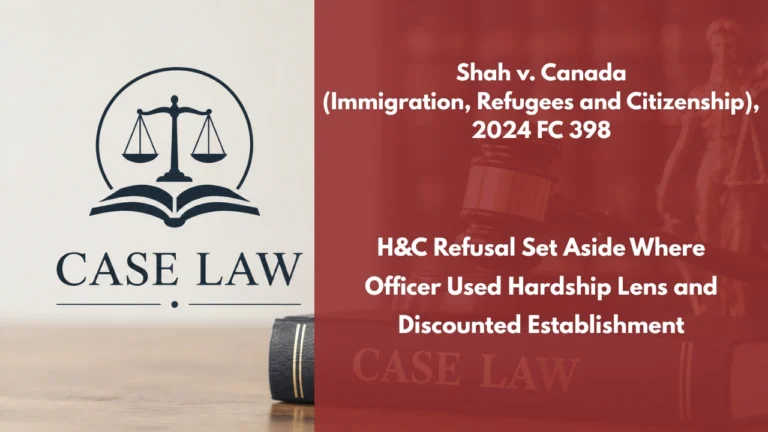
Shah v. Canada (Immigration, Refugees and Citizenship), 2024 FC 398 (CanLII)
Prepared by:
Dr. Muhammad
Abrar (Barrister and
Solicitor)
Author | Writer | Mentor | Legal Researcher | Canadian Immigration Case Law and
Statistics Analyst