The Federal
Court reviewed the refusal of an H&C application filed by a mother and her
two minor children. The family relied heavily on trauma experienced in Germany,
including domestic family circumstances, the father’s suicide, subsequent
harassment, and resulting mental health difficulties. The Court granted
judicial review because the officer’s BIOC analysis was internally inconsistent
and lacked intelligibility.
Key
Principle
An H&C decision must contain an internally coherent and rational
BIOC analysis. Where an officer accepts that removal would cause psychological
harm and expressly finds that remaining in Canada is in the children’s best
interests, the officer cannot later diminish those findings or characterize the
evidence as insufficient without explaining the change in reasoning.
Background
The
applicants had experienced significant family trauma in Germany. They fled the
family home and lived in a shelter, after which the children’s father died by
suicide and the family experienced harassment from his relatives.
Both
children suffered mental health challenges. One child had ADHD, sensory and
speech issues, while the other experienced emotional trauma connected to the
family’s past circumstances.
Court
Findings
• Officer
Initially Found Remaining in Canada Was in the Children’s Best Interests
After
reviewing the medical evidence, the officer accepted that returning to Germany
would psychologically affect the children. The officer expressly concluded that
it would be in their best interests to remain in Canada because of the
emotional trauma associated with return.
• Conclusion
Later Weakened the BIOC Finding
In the final
portion of the reasons, the officer stated that remaining in Canada was only
“somewhat” in the children’s best interests. The Court found no explanation for
why the strength of the earlier BIOC finding had been reduced.
• Emotional
Trauma Findings Were Also Inconsistent
The officer
initially accepted that the children would suffer emotional trauma and
psychological impact if returned. Later, the officer stated only that they
would “likely” face trauma and concluded that there was insufficient evidence
of negative impact.
• Evidence
Sufficiency Concern Appeared Without Explanation
The
officer’s BIOC analysis did not identify any missing or inadequate evidence
concerning psychological harm. The later conclusion that the evidence was
insufficient therefore emerged without a supporting chain of reasoning.
• Access to
Services Did Not Resolve the Contradictions
The officer
noted that the children would remain with their mother and have access to
education, housing, health care, and mental health treatment in Germany. Those
considerations did not explain the inconsistency between the accepted
psychological harm and the later reduced weight assigned to BIOC.
• Reasons
Lacked Intelligibility
The Court
rejected the Minister’s argument that the differing statements were merely more
precise formulations of the same conclusion. The contradictions were
substantive and prevented the reasons from exhibiting the required coherence
and intelligibility.
Outcome
The Federal
Court granted judicial review, set aside the H&C refusal, and returned the
application to a different officer for redetermination. No question was
certified.
Case
Citation:
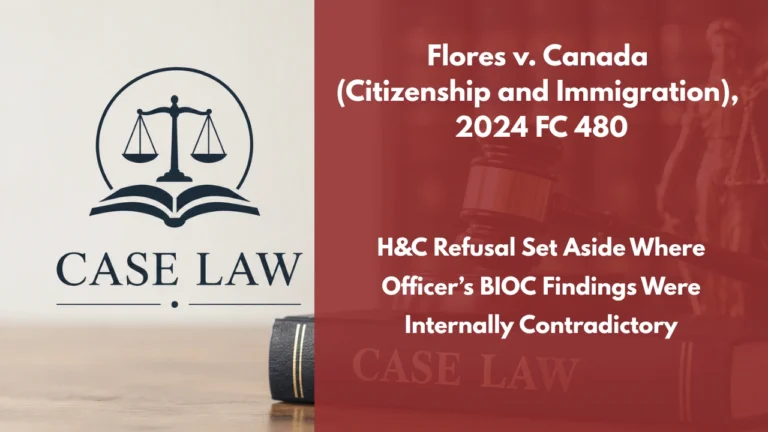
Flores v. Canada (Citizenship and Immigration), 2024 FC 480 (CanLII)
Prepared by:
Dr. Muhammad
Abrar (Barrister and
Solicitor)
Author | Writer | Mentor | Legal Researcher | Canadian Immigration Case Law and
Statistics Analyst