The Federal
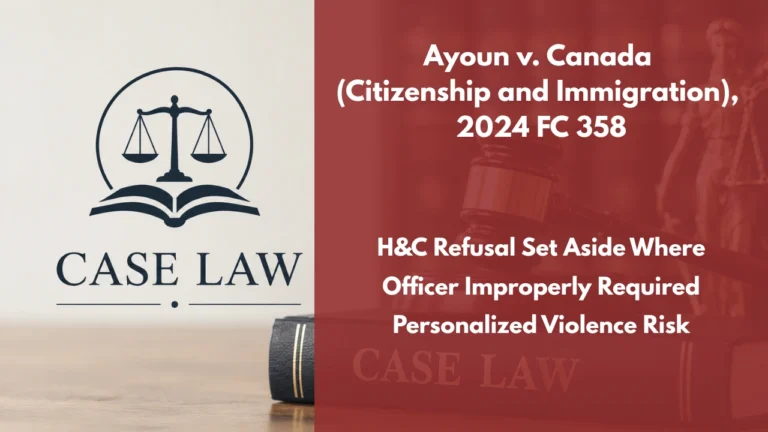
Court reviewed the refusal of a Nigerian family’s PRRA application. The
applicants alleged risks arising from female genital mutilation and persecution
by the principal applicant’s family. The Court granted judicial review because
the officer improperly required a personalized risk under the persecution
analysis and demanded corroboration of sworn evidence without adequate
justification.
Key
Principle
A PRRA officer must keep the legal tests for persecution and
personalized risk distinct. General country-conditioning evidence may support a
persecution claim where it is relevant to the applicants’ circumstances. An
officer also cannot reject or discount a sworn affidavit for lack of
corroboration without providing independent reasons, such as identified
credibility, plausibility, or evidentiary concerns.
Background
The
applicants submitted that they faced persecution and other harm arising from
FGM and threats from the principal applicant’s family. The officer concluded
that the evidence established only generalized risk and that insufficient
evidence showed they would be personally targeted.
Court
Findings
•
Personalized-Risk Requirement Was Misapplied
The officer
repeatedly distinguished between generalized and personalized risk when
assessing persecution. The Court found that this improperly imported a
personalized-risk threshold into the persecution analysis.
• General
Country Evidence Could Support Persecution
The
applicants relied on documentary evidence showing that FGM remained prevalent.
The officer was required to determine whether that general evidence was
relevant to their particular circumstances rather than dismissing it simply
because it was generalized.
• Sworn
Affidavit Was Entitled to Meaningful Consideration
The
principal applicant provided a sworn affidavit supporting the family’s alleged
risks. The officer required further corroboration but did not identify a proper
basis for treating the affidavit as insufficient.
•
Corroboration Requirement Was Unexplained
The officer
did not identify credibility, plausibility, or hearsay concerns that would
justify demanding independent corroborating evidence. The Court held that
requiring corroboration without such reasons undermined the reasonableness of
the decision.
• Officer
Implicitly Rejected Sworn Evidence
By treating
the affidavit as insufficient unless corroborated, the officer effectively
rejected its contents without explaining why its presumed truthfulness should
not be accepted. This was inconsistent with the governing approach to sworn
evidence in PRRA proceedings.
• Oral
Hearing Issue Was Not Determinative
The Court
clarified that an oral hearing was not automatically required merely because
credibility-related concerns could arise. The central problem was the
unexplained corroboration requirement, and the Court therefore did not need to
decide the separate procedural fairness issue.
Outcome
The Federal
Court granted judicial review, set aside the PRRA refusal, and returned the
matter to a different officer for redetermination. No question was certified.
Case
Citation:
Alabi v. Canada (Citizenship and Immigration), 2024 FC 475 (CanLII)
Prepared by:
Dr. Muhammad
Abrar (Barrister and
Solicitor)
Author | Writer | Mentor | Legal Researcher | Canadian Immigration Case Law and
Statistics Analyst