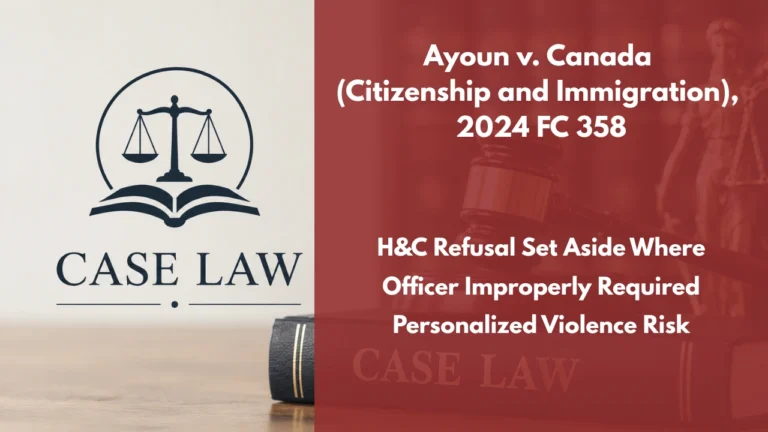
The Federal
Court reviewed the refusal of Eliyahu Ayoun’s H&C application for PR, which
included his wife and two sons. The officer considered establishment, the best
interests of the then-minor child, and country conditions. The Court granted
judicial review because the officer unreasonably assessed the country-condition
evidence by effectively requiring the family to demonstrate a greater risk of
violence than the general population.
Key
Principle
In an H&C assessment, adverse country conditions cannot be
discounted merely because the applicant faces the same risk of violence as
other members of the population. The relevant inquiry is whether the country
conditions contribute to hardship in the applicant’s particular circumstances,
not whether the applicant can establish a uniquely elevated or personalized
risk compared with the general population.
Background
The
applicant and his family entered Canada in July 2018 while he held a work
permit. They applied for H&C relief in April 2021.
The officer
refused the application after considering their establishment in Canada, the
best interests of the younger son, and conditions in Israel.
Court
Findings
•
Country-Condition Analysis Was Determinative
The Court
found that the officer’s treatment of the country-condition evidence was
sufficient to dispose of the judicial review. It was therefore unnecessary to
address the applicant’s other challenges to the H&C decision.
• Officer
Appeared to Require Greater-Than-General Risk
The
officer’s analysis effectively required the family to demonstrate that they
faced a greater risk of becoming victims of violence than the general
population. The Court found this approach unreasonable.
•
Generalized Violence Could Still Be Relevant to H&C
The fact
that a risk is shared by many people does not automatically make it irrelevant
to an H&C hardship assessment. Country conditions must still be assessed as
part of the applicant’s overall circumstances.
• H&C
Analysis Is Distinct From a Protection Claim
The Court’s
conclusion reflects that an H&C application is not limited to determining
whether an applicant faces a uniquely personalized risk. Hardship arising from
broader country conditions may remain relevant even where the applicant is not
more exposed than others.
• Other
H&C Factors Were Not Decided
The
applicant also challenged the officer’s conclusions on other aspects of the
H&C analysis. Because the country-condition error was sufficient to render
the decision unreasonable, the Court did not address those arguments.
Outcome
The Federal
Court granted judicial review, set aside the H&C refusal, and returned the
matter to another officer for redetermination. No question was certified.
Case
Citation:
Ayoun v. Canada (Citizenship and Immigration), 2024 FC 358 (CanLII)
Prepared by:
Dr. Muhammad
Abrar (Barrister and
Solicitor)
Author | Writer | Mentor | Legal Researcher | Canadian Immigration Case Law and
Statistics Analyst