The Federal
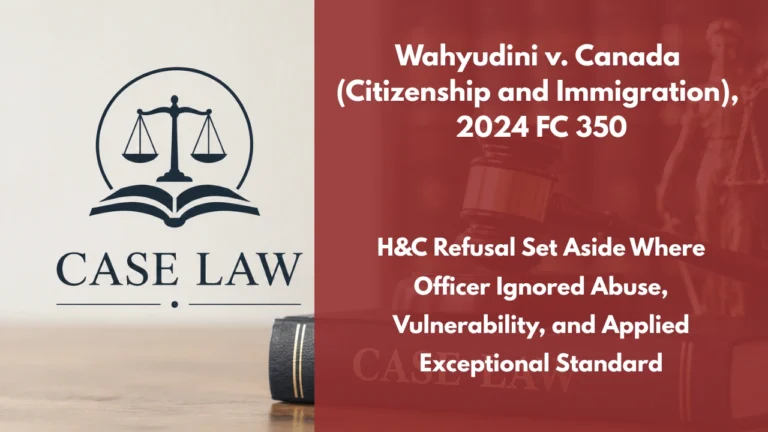
Court reviewed the refusal of Sri Wahyudini’s H&C application for PR. She
had been found inadmissible for indirect misrepresentation after an immigration
agent submitted an altered IELTS certificate without her knowledge, and she
relied on extensive evidence of exploitation, abuse, fraud, vulnerability,
establishment, and hardship. The Court granted judicial review because the
officer failed to meaningfully assess that evidence and applied an improper
exceptionality threshold.
Key
Principle
An H&C officer must assess an applicant’s circumstances
contextually and cannot allow a prior misrepresentation finding to eclipse
material evidence of abuse, exploitation, fraud, vulnerability, and
establishment. H&C relief is exceptional because it operates as an
exception to ordinary immigration requirements, not because applicants must
prove that their establishment or hardship is extraordinary compared with
others.
Background
The
applicant came to Canada as a live-in caregiver and suffered serious abuse and
exploitation by her employer and recruiter. Evidence also showed that she had
previously lost her husband and young son in a house fire, experienced
gender-related vulnerability, received support as a survivor of exploitation,
and built substantial employment and community ties in Canada.
Court
Findings
•
Misrepresentation Did Not Displace the H&C Analysis
The Court
accepted that misrepresentation is serious and relevant. However, the officer
still had to conduct a reasoned assessment of the applicant’s complete personal
circumstances rather than allowing inadmissibility to dominate the analysis.
• Abuse and
Exploitation Evidence Was Ignored
The
applicant’s documented history of severe employer abuse, exploitation, and
fraud was a focal point of her H&C case. The officer’s reasons did not
meaningfully engage with these circumstances or explain the weight assigned to
them.
•
Vulnerability Evidence Required Contextual Assessment
The record
included gender-related evidence, personal trauma, and ongoing support from an
organization assisting survivors of human trafficking and exploitation. Merely
listing some factors could not substitute for explaining how these
vulnerabilities affected the overall H&C assessment.
• Hardship
Analysis Improperly Relied on PRRA Findings
The officer
relied on the outcome of the applicant’s PRRA when considering return hardship.
The Court held that this confused the distinct H&C hardship inquiry and
tainted the analysis of the consequences she could face upon return.
•
Establishment Was Judged Against an Exceptional Standard
The officer
discounted the applicant’s retraining, employment, frontline work, and
volunteer activities because they were not extraordinary or irreplaceable. The
Court found this imposed an impermissibly elevated threshold.
• Global
Conclusion Could Not Cure Missing Analysis
The officer
stated generally that all information had been reviewed. The Court held that
such a conclusion could not replace responsive reasons addressing the
applicant’s central evidence and explaining the chain of reasoning.
Outcome
The Federal
Court granted judicial review and returned the H&C application to a
different officer for redetermination. No question was certified.
Case
Citation:
Wahyudini v. Canada (Citizenship and Immigration), 2024 FC 350 (CanLII)
Prepared by:
Dr. Muhammad
Abrar (Barrister and
Solicitor)
Author | Writer | Mentor | Legal Researcher | Canadian Immigration Case Law and
Statistics Analyst