Introduction
The Federal Court reviewed IRCC’s
refusal of Harmanpreet Singh’s permanent residence application under the
Canadian Experience Class. The officer concluded that the applicant’s
employment at Bhogal Metal Works Inc. as a Tool and Die Maker was not genuine,
leaving him without the required work experience. The applicant sought judicial
review, arguing that the officer unreasonably ignored affidavits and supporting
documentation.
Key Principle
The Federal Court reaffirmed that
a decision is reasonable where it exhibits justification, transparency, and
intelligibility. Courts will not reweigh evidence or substitute their own
assessment where the officer’s decision falls within a range of defensible
outcomes. Alleged misassessment of evidence does not render a decision
unreasonable if the officer has provided sufficient explanation for their
conclusion.
Background
The applicant, a citizen of
India, created an Express Entry profile based on employment at Bhogal Metal
Works Inc., submitting a Provincial Nominee Program nomination and subsequent
permanent residence application. His supporting documents included an undated
letter of employment, letter of offer, T4 slip, Notice of Assessment, and
paystubs covering select periods. IRCC requested additional paystubs covering
January 2022 to February 2024, and the applicant submitted nineteen additional
pay periods and one in August 2023.
The officer issued a procedural
fairness letter (PFL) identifying inconsistencies in the paystubs, the letter
of offer, and the wage rate. The applicant responded with affidavits from
himself and the employer confirming employment, wage increases, and the
administrative errors leading to discrepancies. The officer remained
unconvinced and refused the application.
Court Findings
• Officer’s Assessment Was
Reasonable
The Court held that the officer
provided a rational explanation for rejecting the work experience. The decision
identified specific inconsistencies, evaluated the affidavits, and explained
why the discrepancies undermined the credibility of the claimed employment.
• No Procedural Fairness
Breach
The applicant argued that the
officer should have contacted PNP officials or conducted an interview. The
Court found the applicant was fully aware of the officer’s concerns via the PFL
and had an opportunity to respond. The officer’s reliance on documentary
evidence and PFL responses met procedural fairness requirements.
• Court Cannot Reweigh
Evidence
The applicant’s disagreement with
the officer’s evaluation of affidavits and paystubs does not render the
decision unreasonable. Judicial review does not permit the Court to substitute
its assessment for that of a specialized decision-maker.
Outcome
The Federal Court dismissed the
application for judicial review. The officer’s refusal was justified,
transparent, and intelligible. No question for certification was raised.
Case Citation:
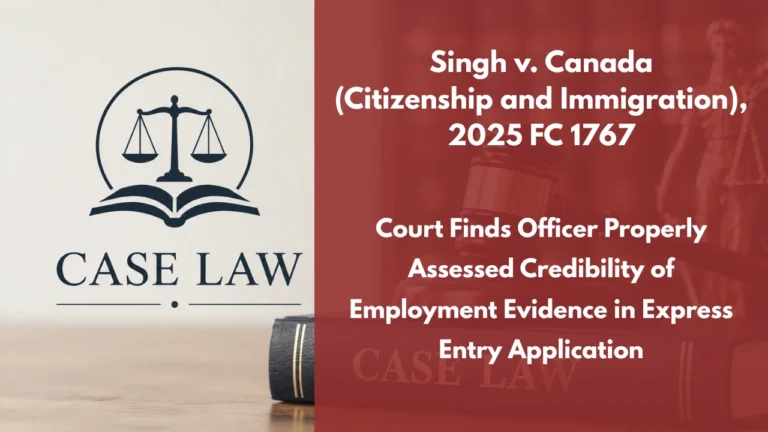
Singh v. Canada (Citizenship and Immigration), 2025 FC 1767 (CanLII)
Prepared by:
Dr. Muhammad Abrar (Barrister and Solicitor)
Author | Writer | Mentor | Legal Researcher | Canadian Immigration Case Law and Statistics Analyst