The Federal Court reviewed IRCC’s refusal of a Temporary
Resident Visa (TRV) and a subsequent Start-Up work permit application submitted
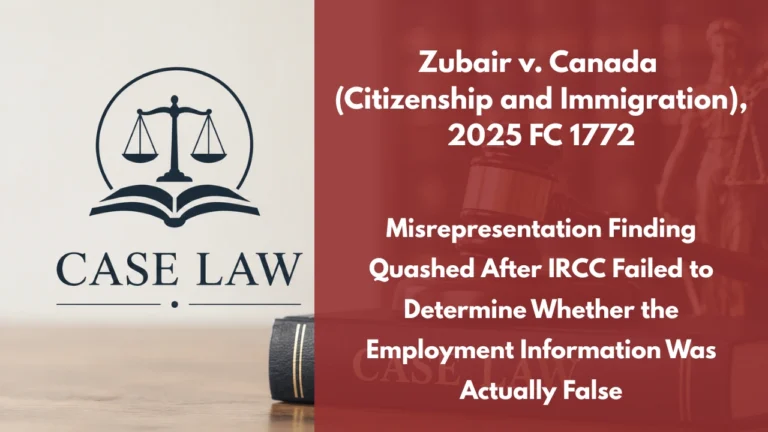
by a Pakistani citizen, Zubair. The TRV was refused on the basis of
misrepresentation under paragraph 40(1)(a) of the Immigration and Refugee
Protection Act (IRPA). The work permit application was denied solely
because of the TRV refusal. The Court found the misrepresentation finding
unreasonable, as the officer failed to properly consider evidence submitted in
response to the procedural fairness letter (PFL) demonstrating that the
employment information was accurate despite minor digital alterations.
Key Principle
The Federal Court reaffirmed that misrepresentation requires
evidence of false or materially misleading information. Alterations in
formatting or digital presentation of a document do not, by themselves,
constitute misrepresentation if the underlying facts are true. Officers must
assess whether the information conveyed is materially false and consider all
evidence provided in response to procedural fairness notices.
Background
The applicant submitted a February 14, 2024, employment
letter from YODO PVT. LTD. as part of his TRV application. The officer
identified digital alterations, including changes in font, bolding, and minor
formatting, and issued a PFL on April 5, 2024, questioning the authenticity of
the employment details. The applicant responded with:
- A
letter from YODO explaining the changes were clerical errors and affirming
the accuracy of the employment information.
- Two
updated employment letters dated April 17, 2024, confirming employment
history, position, and salary.
- Supporting
salary slips, bank payment records, and LinkedIn profile evidence.
Despite this, the officer concluded the response was
insufficient and found the applicant inadmissible for misrepresentation,
triggering a five-year inadmissibility period. The work permit was refused as a
direct consequence of this finding.
Court Findings
• Officer Failed to Assess Material Accuracy
The Court held that the officer did not engage with the
evidence demonstrating that the applicant’s employment information, salary, and
position were accurate. Minor digital alterations did not materially
misrepresent the applicant’s employment history.
• Response to PFL Not Considered
Evidence submitted in response to the PFL, including YODO’s
explanation and supporting documentation, contradicted the officer’s finding.
The officer failed to explain why this evidence did not resolve concerns
regarding misrepresentation.
• Work Permit Refusal Relied Solely on TRV Finding
Because the work permit refusal was based entirely on the
TRV misrepresentation finding, it was also unreasonable.
Outcome
The Federal Court granted the application for judicial
review, set aside the TRV and work permit refusals, and remitted both matters
to a different officer for redetermination. No costs were awarded, and no
question for certification was proposed or arose.
Case Citation:
Zubair v. Canada (Citizenship and Immigration), 2025 FC 1772 (CanLII)
Prepared by:
Dr. Muhammad Abrar (Barrister and Solicitor)
Author | Writer | Mentor | Legal Researcher | Canadian Immigration Case Law and Statistics Analyst