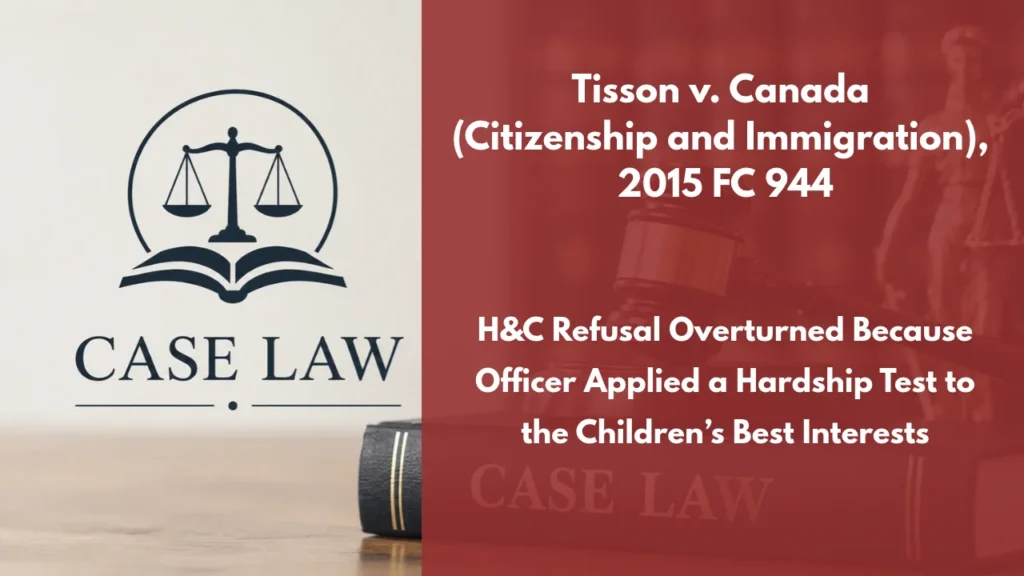
The Federal Court reviewed the refusal of an H&C
application involving a mother from St. Lucia and her two Canadian-born
children.
One of the children had a genetic condition that could
require future surgery.
The Court found that the officer applied the wrong legal
test to the children’s best interests and also breached procedural fairness by
relying on undisclosed Internet research.
Key Principle
When assessing the best interests of a child, an
officer must not require the child to demonstrate a particular level of
hardship.
The proper question is what is actually in the child’s best
interests and how the proposed decision would affect those interests.
An officer must also give an applicant a fair opportunity to
respond where the decision relies on extrinsic information that could not
reasonably have been anticipated.
Background
Ms. Tisson had two Canadian-born children, including a
daughter with craniofrontonasal dysplasia.
The officer accepted that remaining in Canada was probably
in the children’s best interests, but treated that as a relatively minor
positive factor.
The officer also gave considerable negative weight to Ms.
Tisson’s immigration history, including overstaying, unauthorized work, failure
to report for removal, and returning to Canada under a different surname.
Court Findings
The Federal Court found that the officer improperly focused
on whether the daughter would experience “severe” or “significant” problems if she moved to St. Lucia.
That amounted to imposing a hardship threshold on the BIOC
analysis.
The Court emphasized that there is no minimum hardship level
that must be reached before a child’s interests receive meaningful
consideration. The officer was required to assess the children’s unique
circumstances, including medical care, social services, schooling, and the risk
of homelessness.
The Court also found a procedural fairness breach.
The officer independently searched the Internet, including
Wikipedia and related photographs of children with the daughter’s condition,
and apparently relied on that material when assessing the seriousness of her
medical needs.
Because this information was not disclosed to Ms. Tisson,
she had no opportunity to challenge or explain it.
Outcome
The Federal Court allowed the application for judicial
review and returned the H&C application to a different immigration
officer for redetermination.
The case confirms that children’s best interests must be
assessed directly and sensitively, without first requiring proof of exceptional
or severe hardship.
Case Citation:
Tisson v. Canada (Citizenship and Immigration), 2015 FC 944 CanLII
Prepared by:
Dr. Muhammad
Abrar (Barrister and
Solicitor)
Author | Writer | Mentor | Legal Researcher | Canadian
Immigration Case Law and Statistics Analyst