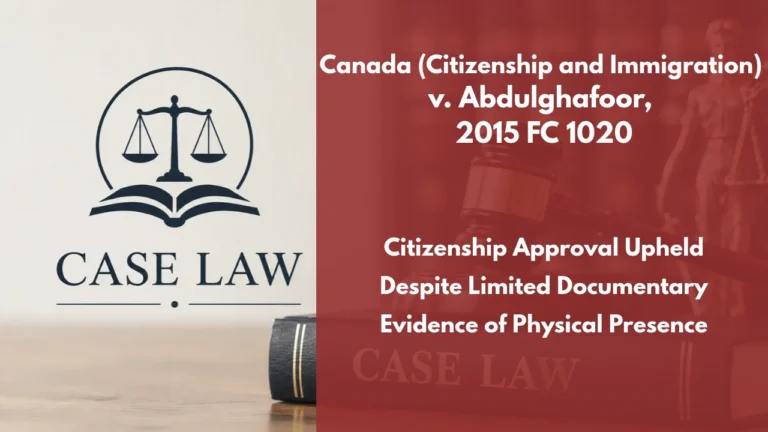
The Federal Court reviewed a Citizenship Judge’s decision
approving a citizenship application despite concerns about limited evidence of
the applicant’s physical presence in Canada.
The Minister argued that there were significant gaps and
discrepancies in the evidence.
The Court nevertheless upheld the citizenship approval.
Key Principle
A citizenship applicant bears the burden of proving the
residence requirement on a balance of probabilities.
However, a reviewing court does not reweigh the evidence
simply because it might have reached a different conclusion.
Where the Citizenship Judge addresses the main concerns,
makes credibility findings, and reaches a conclusion supported by the record,
the decision may remain reasonable even if the documentary evidence is
relatively limited.
Background
The applicant became a permanent resident in 2006 and
applied for citizenship in 2009.
A citizenship officer raised concerns because the applicant
had lost his passport, had little documentary evidence supporting his
residence, and reported no income during the relevant period.
At a hearing, the Citizenship Judge considered these
concerns along with tenancy evidence, tax documents, family records, travel
information, and the applicant’s oral explanations.
The Judge found the applicant credible and concluded that he
met the residence requirement.
Court Findings
The Federal Court acknowledged that the documentary evidence
was limited and that some discrepancies existed.
However, the Citizenship Judge had specifically considered
the lost passport, absence of income, limited banking activity, and travel
history.
The Judge also had the benefit of hearing directly from the
applicant and assessing his credibility.
The Court emphasized that its role was not to substitute its
own assessment of the evidence for that of the Citizenship Judge. Minor or
immaterial errors do not automatically make a decision unreasonable.
The Court also found the reasons adequate. They did not need
to address every individual piece of evidence as long as they explained why the
residence requirement was considered satisfied.
Outcome
The Federal Court dismissed the Minister’s application
for judicial review.
The case confirms that brief reasons and limited documentary
evidence can still support a citizenship decision where the Citizenship Judge
addresses the central concerns and reasonably accepts the applicant’s
explanations and credibility.
Case Citation:
Canada (Citizenship and Immigration) v. Abdulghafoor, 2015 FC 1020 CanLII
Prepared by:
Dr. Muhammad
Abrar (Barrister and
Solicitor)
Author | Writer | Mentor | Legal Researcher | Canadian
Immigration Case Law and Statistics Analyst