Logo of A&M Canadian Immigration law Corporation

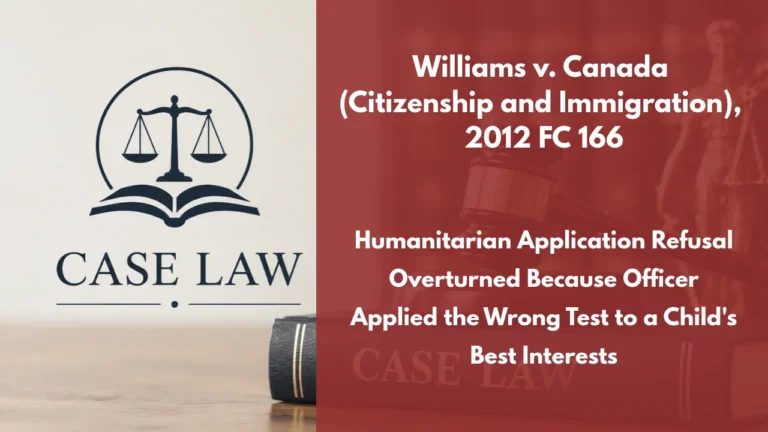
Williams v. Canada (Citizenship and Immigration), 2012 FC 166 : Humanitarian Application Refusal Overturned Because Officer Applied the Wrong Test to a Child’s Best Interests

The Federal Court reviewed the refusal of a permanent residence application submitted on humanitarian and compassionate (H&C) grounds by a Grenadian mother whose Canadian-born son suffered from asthma.

The Court overturned the refusal because the immigration officer improperly assessed the child’s best interests using the legal threshold of unusual, undeserved or disproportionate hardship.

Key Principle

Under subsection 25(1) of the Immigration and Refugee Protection Act (IRPA), immigration officers must consider the best interests of children directly affected by an H&C decision.

The best interests of a child must be assessed independently from the hardship threshold applied to an applicant’s personal circumstances.

Officers must determine what is in the child’s best interests, assess how the available decisions would affect those interests, and assign appropriate weight to them.

A child does not need to experience exceptional suffering or deprivation of basic necessities before their best interests deserve positive consideration.

Background

Erlina Mary Williams, a Grenadian citizen, previously lived in Canada and gave birth to her son, Omar, who acquired Canadian citizenship.

She sought refugee protection based on alleged domestic abuse but was unsuccessful.

Following a negative Pre-Removal Risk Assessment, she voluntarily returned to Grenada with Omar in August 2007.

Ms. Williams pursued an H&C application, explaining that Omar suffered from asthma, which she claimed had worsened because of Grenada’s climate.

She submitted medical evidence and raised concerns about the affordability of medication, access to healthcare and her financial circumstances.

In April 2011, the immigration officer refused her application, concluding that neither she nor Omar experienced sufficient hardship to justify H&C relief.

Court Findings

The Federal Court identified a fundamental legal error.

First, the officer incorrectly applied the hardship threshold to the child’s best interests.

Rather than examining what circumstances would best support Omar’s health and well-being, the officer focused on whether he suffered unusual or disproportionate hardship.

Second, the officer treated satisfaction of basic needs as sufficient.

The Court emphasized that access to some medical treatment, education and family support does not conclude a child’s best-interests assessment.

Third, the officer failed to properly examine Omar’s individual circumstances.

The assessment did not adequately address the alleged worsening of his asthma in Grenada or meaningfully consider his circumstances from his perspective.

The Court confirmed that children’s interests must receive substantial consideration, although they do not automatically determine the outcome.

Outcome

The Federal Court allowed judicial review, quashed the H&C refusal and returned the application to a different immigration officer for reconsideration.

The decision establishes that officers cannot substitute a hardship assessment for a genuine, individualized analysis of a child’s best interests.

The Court did not grant permanent residence.

No question of general importance was certified.


Case Citation:

Williams v. Canada (Citizenship and Immigration), 2012 FC 166 CanLII
Visit our Social Media:

CATEGORIES

Case Law Library (1428)Case Law Update - January 2026 (13)Case Law Update - February 2026 (9)Case Law Update - March 2026 (13)Case Law Update - April 2026 (9)Case Law Update - May 2012 (6)Case Law Update - May 2013 (5)Case Law Update - May 2014 (6)Case Law Update - May 2015 (9)Case Law Update - May 2016 (7)Case Law Update - May 2017 (4)Case Law Update - May 2018 (4)Case Law Update - May 2019 (3)Case Law Update - May 2020 (4)Case Law Update - May 2021 (6)Case Law Update - May 2022 (10)Case Law Update - May 2023 (10)Case Law Update - May 2024 (13)Case Law Update - May 2026 (10)Case Law Update – May 2025 (18)Case Law Update - June 2026 (24)Case Law Update - October 2026 (11)Case Law Update - Apr. 2012 (12)Case Law Update - Apr. 2013 (4)Case Law Update - Apr. 2014 (3)Case Law Update - Apr. 2015 (9)Case Law Update - Apr. 2016 (8)Case Law Update - Apr. 2017 (6)Case Law Update - Apr. 2018 (7)Case Law Update - Apr. 2019 (6)Case Law Update - Apr. 2020 (8)Case Law Update - Apr. 2022 (11)Case Law Update - Apr. 2023 (11)Case Law Update - Apr. 2024 (14)Case Law Update - Aug. 2012 (6)Case Law Update - Aug. 2013 (5)Case Law Update - Aug. 2014 (7)Case Law Update - Aug. 2015 (10)Case Law Update - Aug. 2016 (3)Case Law Update - Aug. 2017 (4)Case Law Update - Aug. 2018 (5)Case Law Update - Aug. 2019 (4)Case Law Update - Aug. 2020 (5)Case Law Update - Aug. 2021 (8)Case Law Update - Aug. 2022 (7)Case Law Update - Aug. 2023 (10)Case Law Update - Aug. 2024 (7)Case Law Update - Aug. 2026 (8)Case Law Update - Dec. 2012 (7)Case Law Update - Dec. 2013 (4)Case Law Update - Dec. 2014 (3)Case Law Update - Dec. 2015 (3)Case Law Update - Dec. 2016 (3)Case Law Update - Dec. 2017 (5)Case Law Update - Dec. 2018 (7)Case Law Update - Dec. 2019 (5)Case Law Update - Dec. 2020 (5)Case Law Update - Dec. 2021 (9)Case Law Update - Dec. 2023 (6)Case Law Update - Dec. 2024 (15)Case Law Update - Dec. 2025 (11)Case Law Update - Feb. 2012 (11)Case Law Update - Feb. 2013 (7)Case Law Update - Feb. 2014 (4)Case Law Update - Feb. 2015 (5)Case Law Update - Feb. 2016 (7)Case Law Update - Feb. 2017 (8)Case Law Update - Feb. 2018 (8)Case Law Update - Feb. 2019 (6)Case Law Update - Feb. 2020 (7)Case Law Update - Feb. 2021 (3)Case Law Update - Feb. 2022 (11)Case Law Update - Feb. 2023 (14)Case Law Update - Feb. 2024 (16)Case Law Update - Jan. 2012 (5)Case Law Update - Jan. 2013 (6)Case Law Update - Jan. 2014 (7)Case Law Update - Jan. 2015 (9)Case Law Update - Jan. 2016 (7)Case Law Update - Jan. 2017 (8)Case Law Update - Jan. 2018 (8)Case Law Update - Jan. 2019 (6)Case Law Update - Jan. 2020 (11)Case Law Update - Jan. 2021 (3)Case Law Update - Jan. 2022 (7)Case Law Update - Jan. 2023 (9)Case Law Update - Jan. 2024 (13)Case Law Update - Jul. 2012 (7)Case Law Update - Jul. 2013 (11)Case Law Update - Jul. 2014 (7)Case Law Update - Jul. 2015 (5)Case Law Update - Jul. 2016 (13)Case Law Update - Jul. 2017 (5)Case Law Update - Jul. 2018 (8)Case Law Update - Jul. 2019 (7)Case Law Update - Jul. 2020 (4)Case Law Update - Jul. 2021 (9)Case Law Update - Jul. 2022 (7)Case Law Update - Jul. 2023 (11)Case Law Update - Jul. 2024 (16)Case Law Update - Jul. 2025 (16)Case Law Update - Jul. 2026 (13)Case Law Update - Jun. 2012 (8)Case Law Update - Jun. 2013 (6)Case Law Update - Jun. 2014 (4)Case Law Update - Jun. 2015 (9)Case Law Update - Jun. 2016 (4)Case Law Update - Jun. 2017 (5)Case Law Update - Jun. 2018 (6)Case Law Update - Jun. 2019 (6)Case Law Update - Jun. 2020 (4)Case Law Update - Jun. 2021 (14)Case Law Update - Jun. 2022 (9)Case Law Update - Jun. 2023 (10)Case Law Update - Jun. 2024 (16)Case Law Update - Jun. 2025 (9)Case Law Update - Mar. 2012 (7)Case Law Update - Mar. 2013 (7)Case Law Update - Mar. 2014 (6)Case Law Update - Mar. 2015 (8)Case Law Update - Mar. 2016 (7)Case Law Update - Mar. 2017 (4)Case Law Update - Mar. 2018 (8)Case Law Update - Mar. 2019 (8)Case Law Update - Mar. 2020 (9)Case Law Update - Mar. 2021 (2)Case Law Update - Mar. 2022 (10)Case Law Update - Mar. 2023 (11)Case Law Update - Mar. 2024 (15)Case Law Update - Nov. 2012 (6)Case Law Update - Nov. 2013 (6)Case Law Update - Nov. 2014 (5)Case Law Update - Nov. 2015 (5)Case Law Update - Nov. 2016 (6)Case Law Update - Nov. 2017 (5)Case Law Update - Nov. 2018 (5)Case Law Update - Nov. 2019 (5)Case Law Update - Nov. 2020 (2)Case Law Update - Nov. 2021 (11)Case Law Update - Nov. 2023 (12)Case Law Update - Nov. 2024 (14)Case Law Update - Nov. 2025 (11)Case Law Update - Oct. 2012 (5)Case Law Update - Oct. 2013 (4)Case Law Update - Oct. 2014 (4)Case Law Update - Oct. 2015 (6)Case Law Update - Oct. 2016 (7)Case Law Update - Oct. 2017 (5)Case Law Update - Oct. 2018 (8)Case Law Update - Oct. 2019 (8)Case Law Update - Oct. 2020 (1)Case Law Update - Oct. 2021 (10)Case Law Update - Oct. 2023 (10)Case Law Update - Oct. 2024 (16)Case Law Update - Oct. 2025 (13)Case Law Update - Sep. 2012 (7)Case Law Update - Sep. 2013 (4)Case Law Update - Sep. 2014 (8)Case Law Update - Sep. 2015 (7)Case Law Update - Sep. 2016 (10)Case Law Update - Sep. 2017 (4)Case Law Update - Sep. 2018 (5)Case Law Update - Sep. 2019 (7)Case Law Update - Sep. 2020 (3)Case Law Update - Sep. 2021 (10)Case Law Update - Sep. 2022 (10)Case Law Update - Sep. 2023 (6)Case Law Update - Sep. 2024 (15)Case Law Update - Sep. 2025 (17)Case Law Update - Sep. 2026 (13)Case Law Update – Apr. 2021 (4)Case Law Update – Apr. 2025 (9)Case Law Update – Aug. 2025 (8)Case Law Update – Dec. 2022 (10)Case Law Update – Feb. 2025 (8)Case Law Update – Jan. 2025 (17)Case Law Update – Mar. 2025 (17)Case Law Update – Nov. 2022 (11)Case Law Update – Oct. 2022 (6)

About The Author

Picture of Dr. Muhammad Abrar

Dr. Muhammad Abrar

Barrister & Solicitor

From temporary status to PR, get expert legal help to choose the right immigration pathway.

Contact our office for details. Our immigration legal service in Winnipeg will assess your eligibility per CIC criteria and submit your application.