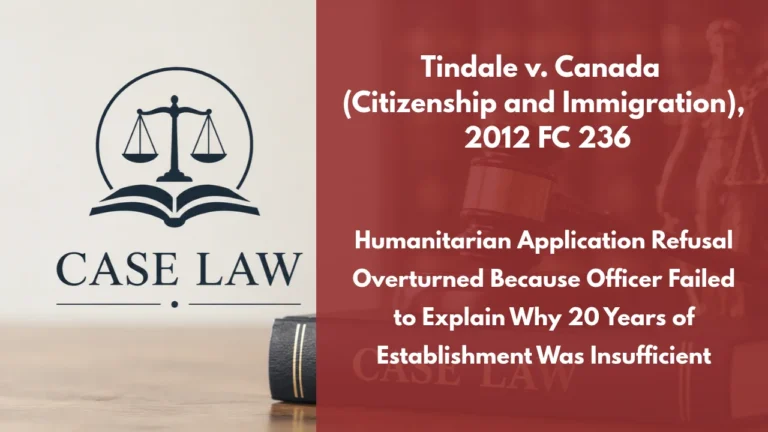
The Federal Court reviewed the refusal of a permanent
residence application submitted on humanitarian and compassionate (H&C)
grounds by a Jamaican citizen who had lived in Canada for over 20 years.
The Court overturned the refusal because the immigration
officer failed to adequately explain why the applicant’s lengthy establishment
in Canada was insufficient to justify H&C relief.
Key Principle
Under section 25 of the Immigration and Refugee Protection
Act (IRPA), immigration officers have discretion to grant relief based on
humanitarian and compassionate circumstances.
An officer cannot simply acknowledge positive establishment
factors and conclude that they are insufficient without explaining how the
evidence supports that conclusion.
Although H&C decisions involve considerable discretion,
the reasons must demonstrate a logical connection between the evidence
considered and the final decision.
Background
Arline Tindale, a Jamaican citizen, fled an abusive marriage
and entered Canada with her youngest son, leaving several other children behind
in Jamaica.
She remained in Canada for more than 20 years without legal
immigration status.
During this period, she made several unsuccessful attempts
to regularize her status, including refugee protection claims, Pre-Removal Risk
Assessments (PRRA) and an earlier H&C application.
In June 2011, her second H&C application was refused.
The officer acknowledged that leaving Canada after more than
two decades could be difficult but concluded that her establishment was
insufficient to demonstrate unusual, undeserved or disproportionate hardship.
Ms. Tindale challenged the refusal, arguing that the officer
had not adequately explained this conclusion.
Court Findings
The Federal Court found that the officer’s reasoning was
unreasonable.
First, the officer identified relevant establishment factors
but failed to meaningfully analyze them.
Although the officer acknowledged Ms. Tindale’s lengthy
residence in Canada, the decision did not explain why her circumstances were
insufficient to justify relief.
Second, the conclusion was disconnected from the evidence
presented.
The Court observed that a fair reading of the reasons
appeared to support a conclusion opposite to the one reached by the officer.
Third, discretionary decisions must still contain adequate
justification.
The Court emphasized that immigration officers have broad
discretion in H&C matters, but this discretion does not permit unexplained
or arbitrary conclusions.
Simply summarizing evidence and declaring it insufficient
does not constitute a reasonable assessment.
Outcome
The Federal Court allowed judicial review, set aside the
H&C refusal and returned the application to a different immigration officer
for reconsideration.
The decision confirms that H&C refusals must
meaningfully explain why an applicant’s establishment and personal
circumstances do not justify relief.
The Court did not directly grant permanent residence.
No question of general importance was certified.
Case Citation:
Tindale v. Canada (Citizenship and Immigration), 2012 FC 236 CanLII