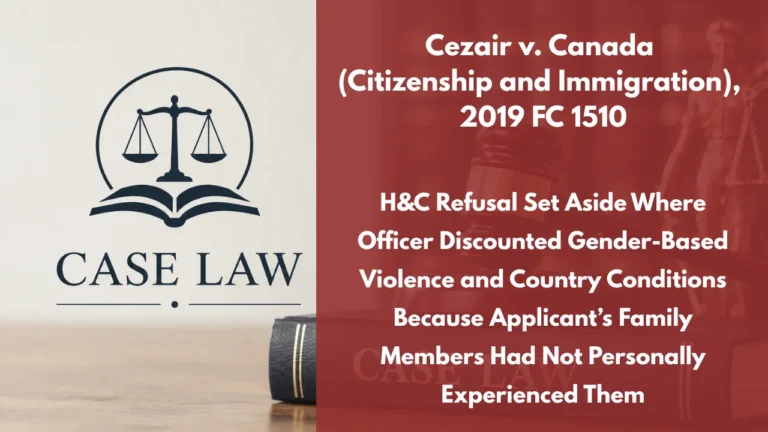
The Federal Court reviewed the refusal of an inland
permanent residence application based on humanitarian and compassionate
grounds.
The applicant had lived in Canada for more than 20 years and
relied in part on evidence of violent crime, gender-based violence, and
discrimination against women in Trinidad and Tobago.
The officer gave those country conditions only nominal
weight because there was no evidence that the applicant’s relatives in Trinidad
had personally experienced violence or discrimination. The Court found that
reasoning unreasonable.
Key Principle
An H&C applicant relying on adverse country conditions
must demonstrate a sufficient connection between those conditions and their
personal circumstances.
However, that connection does not necessarily require
evidence that the applicant or their relatives have already personally
experienced the harm.
Where country evidence demonstrates widespread violence,
discrimination, or gender-based violence affecting a particular group, an
applicant’s membership in that group may provide the required personal
connection.
An officer cannot reasonably discount such evidence merely
because family members belonging to the same group have not themselves been
victims.
Background
The applicant was a citizen of Trinidad and Tobago who
entered Canada as a visitor in 1998 and remained after her status expired.
She applied for H&C relief in 2017, relying on her
lengthy establishment in Canada, employment, community and church involvement,
personal relationships, and hardship associated with returning to Trinidad and
Tobago.
Her application also relied significantly on country
evidence concerning widespread violence, discrimination against women, and
gender-based violence.
The officer acknowledged these conditions but assigned them
only nominal weight. Among the reasons given was the absence of evidence
showing that the applicant’s siblings, father, sisters, or sisters-in-law in
Trinidad had themselves experienced violence or discrimination.
Court Findings
The Court found that the officer’s approach to the country
condition evidence was unreasonable.
With respect to general violent crime, the officer reasoned
that if conditions were as dangerous as alleged, one might expect at least some
of the applicant’s family members to have personally experienced violence.
The Court rejected that reasoning. The absence of harm to
particular relatives was not a rational basis for minimizing objective evidence
of widespread violence.
The error was even clearer regarding gender-based violence
and discrimination. The officer discounted this evidence because the applicant
had not shown that her sisters and sisters-in-law had personally encountered
discrimination in employment, housing, education, or access to police
protection.
The Court held that this effectively created an improper
requirement that family members must first have experienced discrimination or
violence before broader evidence of pervasive gender-based conditions could
receive meaningful weight.
The Court emphasized that where the evidence concerns broad
risks affecting a group, showing membership in that group may be sufficient to
establish the necessary connection. The fact that some members of the group
have not been harmed does not negate the existence or relevance of the broader
risk.
The Court did not accept the applicant’s other principal
arguments. It found that the officer had not improperly applied a hardship-only
test, had conducted a global assessment of the H&C factors, and had not
breached procedural fairness by consulting publicly available information about
Catholic churches in Trinidad and Tobago.
Outcome
The Federal Court allowed the application for judicial
review, finding that the unreasonable assessment of the country condition
evidence undermined the H&C decision as a whole. The matter was remitted to
a different officer for redetermination.
Case Citation:
Cezair v. Canada (Citizenship and Immigration), 2019 FC 1510 CanLII
Prepared by:
Dr. Muhammad Abrar (Barrister and Solicitor)
Author | Writer | Mentor | Legal Researcher | Canadian Immigration Case Law and Statistics Analyst