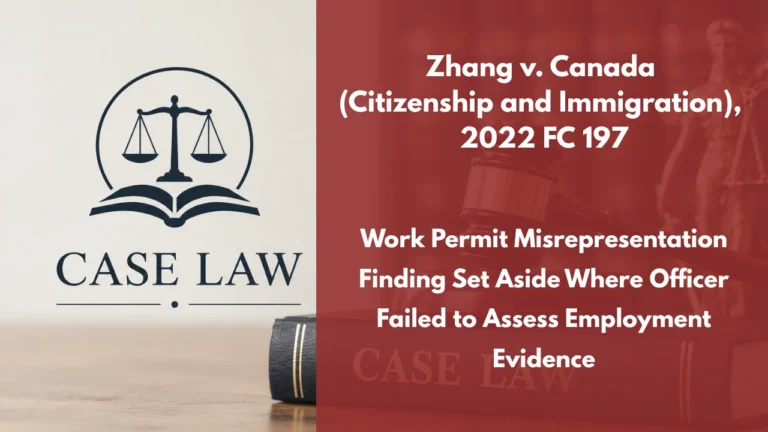
The Federal Court reviewed Yan Zhang’s work
permit refusal and five-year inadmissibility finding for misrepresentation. The
officer concluded that she had submitted fraudulent employment evidence
concerning her claimed work as a cook. The Court found the decision
unreasonable and procedurally unfair because the officer failed to meaningfully
assess corroborating documents, explain why they were unreliable, or justify a
severe inadmissibility finding on the record.
Key Principle
A misrepresentation
finding must rest on clear and convincing evidence and reasons that
meaningfully engage with the applicant’s explanations and corroborating
documents. General concerns about document fraud or unfamiliar formatting
cannot replace an examination of the actual evidence, particularly where the
finding carries a five-year inadmissibility consequence.
Background
The applicant received an LMIA-supported cook
job offer. After a procedural fairness letter questioned her prior employment
at Jingcan Restaurant, she provided additional documents explaining why no
employee insurance policy existed for later years and submitted corroborating
evidence. The officer nevertheless found that her employment history and
supporting documents were fraudulent.
Court Findings
• Officer Failed to Assess the Actual
Documents
The officer was entitled to consider local
knowledge about document fraud, but could not reject foreign documents simply
because fraudulent documents may be available. The Court found that the officer
did not meaningfully examine the corroborating materials submitted by the
applicant or explain what weight, if any, was assigned to them.
• Unfamiliar Formatting Was Not Enough
The officer noted that a China Life support
letter did not match the format expected and that notarized materials were
unusual. The Court held that these observations did not establish fraud. If the
documents themselves contained specific indicators of fabrication, the officer
had to identify and explain those concerns rather than rely on generalized
suspicion.
• Corroborating Employment Evidence Was
Improperly Discounted
The applicant provided letters from
co-workers, the restaurant owner, pay stubs, and other records supporting her
employment. The officer found them insufficient without giving an intelligible
evidentiary basis. The Court found the conclusion speculative and insufficient
to support an implicit finding that the documents were not genuine.
• Failure to Verify Evidence Undermined the
Analysis
Although the applicant bore the burden of
proving her employment, contact information had been provided with the
corroborating documents. The Court noted that the officer did not use that
information to verify authenticity despite relying heavily on doubts about
whether the evidence was genuine.
• Procedural Fairness Was Heightened by
Misrepresentation Consequences
A temporary work permit normally attracts a
low level of procedural fairness, but a misrepresentation finding carries a
five-year bar and serious consequences for an applicant’s status and character.
The Court therefore required clearer reasons addressing the applicant’s
evidence and explanations.
• Misrepresentation Finding Lacked Clear and
Convincing Evidence
The officer’s reasons did not adequately
explain why the applicant’s responses to the procedural fairness concerns
established fraudulent conduct. If credibility remained in issue, the officer
had to provide a meaningful opportunity to address it. The Court concluded that
the finding lacked clear and convincing evidentiary support.
Outcome
The Federal Court granted judicial review and
remitted the matter to a different officer for redetermination. No question was
certified.
Case Citation:
Zhang v. Canada (Citizenship and Immigration), 2022 FC 197 (CanLII)
Written by:
Dr. Muhammad
Abrar (Barrister and
Solicitor)
Author | Writer | Mentor | Legal Researcher | Canadian Immigration Case Law and
Statistics Analyst