


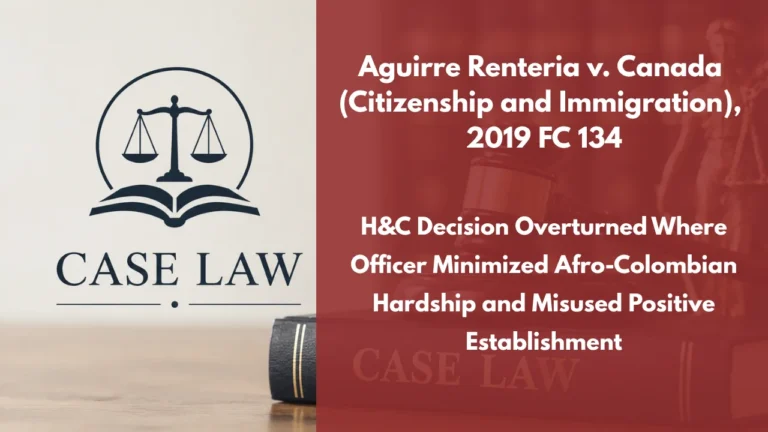

In Aguirre Renteria v. Canada (Citizenship and
Immigration), 2019 FC 134, the Federal Court reviewed the refusal of an
application for permanent residence based on humanitarian and compassionate
grounds.
The applicant, an Afro-Colombian national, argued that the
officer failed to properly assess evidence concerning discrimination against
Afro-Colombians, improperly linked his credibility to findings made against his
sister in an earlier refugee proceeding, and treated his establishment in
Canada as evidence that he could successfully readapt to Colombia.
The Court agreed that the officer’s reasoning was inadequate
and set the decision aside.
Key Principle
Where an H&C applicant presents significant evidence
showing that conditions in the country of return are materially worse because
of race, ethnicity, or another personal characteristic, the officer must meaningfully
engage with that evidence.
It is insufficient to simply acknowledge that conditions are
“less than favourable” and assign the factor some positive weight without
explaining why the evidence does not justify H&C relief.
Further, positive establishment in Canada should be
treated as a positive H&C consideration and should not be transformed into
evidence that the applicant will successfully re-establish abroad.
Background
The applicant sought H&C relief based in part on the
conditions he would face in Colombia as an Afro-Colombian.
The record contained substantial country-condition evidence
indicating that Afro-Colombians experienced widespread discrimination and
socio-economic disadvantage.
The officer acknowledged that conditions for Afro-Colombians
were “less than favourable” and stated that this factor was given favourable
consideration. However, the officer also noted that the applicant had not
raised his ethnicity during his refugee claim and had not shown that his sister
in Colombia was suffering hardship because of her ethnicity.
The officer further relied on adverse credibility findings
made by the Refugee Protection Division concerning the applicant’s sister and
treated the applicant’s Canadian establishment and adaptability as factors
supporting his ability to return to Colombia.
Court Findings
The Federal Court found the treatment of the
country-condition evidence inadequate.
The Court held that where an applicant faces conditions
materially inferior to Canadian standards, the officer must explain why the
evidence is insufficient to warrant relief. A generalized acknowledgment
that conditions are “less than favourable” does not demonstrate meaningful
consideration of substantial evidence concerning discrimination.
The Court also rejected the significance placed on the
applicant’s failure to raise his ethnicity during his refugee claim. The
earlier refugee claim concerned an alleged risk from the FARC. The Court
observed that discrimination, even when persistent, does not necessarily rise
to the level of persecution required for refugee protection. The absence of
ethnicity from the refugee claim therefore did not undermine its relevance to
an H&C assessment.
The Court also questioned why adverse credibility findings
concerning the applicant’s sister were attributed to the applicant himself.
Finally, the Court criticized the officer for using the
applicant’s successful establishment in Canada against him by reasoning that
his adaptability demonstrated an ability to re-establish in Colombia. The Court
confirmed that credit should be given for Canadian establishment rather than
turning that positive factor into a reason to deny relief.
Outcome
The Federal Court allowed the application for judicial
review, set aside the H&C refusal, and ordered that the matter be
redetermined by a different decision-maker. The applicant was also permitted to
supplement his evidence because of the passage of time.
Case
Citation:
Aguirre Renteria v. Canada (Citizenship and Immigration), 2019 FC 134 CanLII
Prepared by:
Dr. Muhammad
Abrar (Barrister and
Solicitor)
Author | Writer | Mentor | Legal Researcher | Canadian Immigration Case Law and
Statistics Analyst

Barrister & Solicitor
From temporary status to PR, get expert legal help to choose the right immigration pathway.








© 2026 A&M Canadian Immigration Law Corporation | All Rights Reserved.